What Is a Loan Document Checklist?

A loan document checklist is a list of the information and files a borrower may need before applying for a loan. It usually covers identity, income, banking, and contact details, and it helps you organize everything a lender may request. Requirements vary by lender, state, loan type, and borrower profile, so a checklist helps you avoid missing or unreadable files.
At CreditCube, a tribal installment lender that offers tribal loans, applicants may be asked to provide information that helps verify identity, income, banking details, and repayment ability. Having your documents ready may help streamline the application review, though it does not guarantee approval, loan amount, terms, or funding timing.
In this guide, we explain what to prepare, why lenders request it, and how to avoid common document issues before you submit.
Loan Document Checklist: What to Prepare Before You Apply
Your loan document checklist starts with the basics most lenders review: who you are, how you earn, and where you bank. In the table below, you’ll find the common documents grouped by category, along with why each one may be requested. You may not need every item, since what a lender asks for depends on your situation.
| Document category | Examples | Why it may be requested |
|---|---|---|
| Identity information | Driver's license, state ID, passport, government-issued ID | To confirm who is applying |
| Contact information | Phone number, email, current address | To communicate about the application |
| Income information | Pay stubs, benefit statements, direct deposit records, tax documents | To review ability to repay |
| Bank account information | Checking account details, recent bank activity, account verification | To confirm payment and funding details |
| Employment information | Employer name, job title, work phone, length of employment | To verify income source |
| Address information | Utility bill, lease, bank statement, ID address | To confirm residence if needed |
| Additional documents | Tax returns, 1099 forms, self-employment records, requested clarifications | To support lender review when standard documents are not enough |
Not every applicant needs every document, so treat this as a starting point and follow the lender’s specific requests.
How Does a Loan Document Checklist Streamline Application Review?
A loan document checklist streamlines application review by cutting down on missing information, unreadable uploads, and mismatched details. When your files are complete and consistent, the lender can review your application with fewer follow-up requests. It does not guarantee approval, but it may help the process move with less back-and-forth.
To use a checklist well, work through these steps before you apply:
- Review the lender’s application requirements.
- Prepare your identity document.
- Gather recent income information.
- Check that your bank account details are accurate.
- Make sure every file is clear and readable.
- Confirm that names, addresses, and income details match across your documents.
- Keep everything available in case the lender requests more.
A complete loan document checklist may help streamline the application with fewer surprises.
Why Do Lenders Ask for Loan Documents?
Lenders ask for loan documents to confirm who you are and to judge whether repayment appears realistic. The review may cover identity verification, income review, bank account verification, and an ability-to-repay assessment. These documents also help lenders reduce fraud and check basic eligibility before making a decision.
For installment loans, this review may include identity, income, banking information, and other details relevant to the application. The goal is to understand your situation, not to collect paperwork for its own sake, so each request usually ties back to eligibility or repayment. Building your loan document checklist around these needs can make the review smoother.
CreditCube’s Application Process, Step by Step
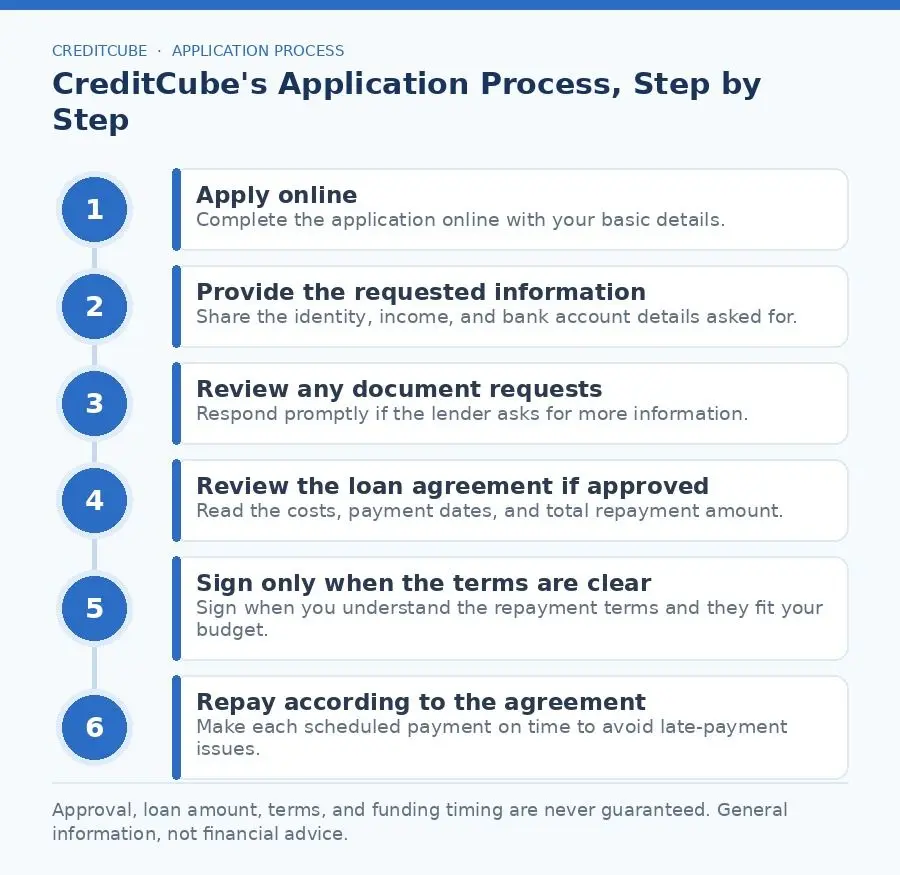
CreditCube’s application process starts online and moves through a few clear steps, from your first form to final repayment. Here is what to expect at each stage before you commit.
-
Apply online Begin the process online by completing the application with your basic details. A complete form helps the review start without delay.
-
Provide the requested information Share the identity, income, and bank account details CreditCube asks for during review. Accurate details reduce the chance of a follow-up request.
-
Review any document requests If the lender needs more, respond to document requests promptly. Quick responses help keep the review moving.
-
Review the loan agreement if approved If approved, read the full agreement, including the costs, payment dates, and total repayment amount. This is the point to confirm the loan fits your budget.
-
Sign only when the terms are clear Sign the agreement only when you understand the repayment terms. If anything is unclear, ask before you agree.
-
Repay according to the final agreement Make each scheduled payment on time as set by the loan agreement. Staying on schedule helps you avoid late-payment consequences.
CreditCube may request information related to identity, income, bank account details, and repayment ability during this review. Approval, loan amount, terms, and funding timing are never guaranteed, so you should read every term before you agree. CreditCube is a tribal installment loan provider, not a traditional payday lender. CreditCube installment loans are an expensive form of borrowing, so compare the total cost with other options before you apply.
Loan Document Checklist by Income Type
The documents you prepare can depend on how you earn your income. Use the sections below to see which items may apply to your situation.
If you are employed, documents that may be requested include:
- Recent pay stubs
- Employer information
- Direct deposit records
- Bank statements
- A government-issued ID
If you are self-employed, documents that may be requested include:
- Recent tax returns
- 1099 forms
- Bank statements
- Business income records
- Profit and loss information, if applicable
If you receive benefits or other regular income, documents that may be requested include:
- A benefit award letter
- Direct deposit records
- Bank statements
- Other proof of regular income
No income type guarantees approval, and lenders still review the full application before making a decision.
Which Common Document Mistakes Can Delay an Application?
A few small mistakes on your loan document checklist can slow down an application by creating extra review steps. Watch for these common issues before you submit:
- Uploading blurry photos
- Submitting an expired ID
- Using documents with different names or addresses
- Providing outdated income documents
- Cropping off important details
- Uploading password-protected files
- Entering information that does not match your documents
- Ignoring follow-up requests
- Leaving required application fields blank
Before submitting, check that your loan documents are current, complete, readable, and consistent with the information on your application.
How to Organize Loan Documents Before Applying Online
Organizing your loan documents before applying online makes the upload step faster and reduces errors. Save each document as a clear photo or PDF, use simple file names, and keep your ID, income, and bank files separate. Make sure every corner of the document is visible, and avoid screenshots that cut off dates, names, or account details.
Simple file names help, such as LastName-ID, LastName-Income, LastName-BankStatement, and LastName-AddressProof. If you are sharing bank statements, it helps to understand the difference between your statement balance vs. current balance so the figures match what the lender expects. Use a secure device and a private internet connection. Share documents only through the lender’s official, secure upload process after confirming you are on the lender’s official website, and do not send them by email, text, or through unsolicited links. If the lender lets you sign online, you will be asked to consent to receive your loan documents electronically, and you can ask how to get paper copies or how to withdraw that consent. You can also learn how to e-sign loan documents before you complete the final step. A tidy loan document checklist makes this upload step quicker and reduces repeat requests.
What Should You Check Before Signing a Loan Agreement?
Preparing your documents is only one part of the process, so review the full agreement before you sign. Start with the loan amount, the total repayment amount, and the payment schedule, along with the APR, finance charge, and fees shown in the agreement’s disclosures.
Check the due dates, the consequences of late payments, and whether the loan is available in your state. Make sure the repayment fits your budget, and keep the lender’s contact information in case you have questions. A loan should fit your budget and not create additional financial pressure.
When Borrowing May Not Be the Right Move
Borrowing may not be the right move when it would add pressure you cannot manage. A loan may not fit your situation when:
- You are unsure how you will repay
- You already have several unpaid debts
- The loan would make essential bills harder to cover
- You would need another loan to repay this one
- You do not understand the full repayment terms
- The expense can be delayed or handled another way
If any of these apply, it is worth pausing to review lower-cost options before you borrow.
Alternatives to Consider Before Applying
A loan is one possible tool, not the only option, so it helps to compare alternatives first. These options may cost less or create less repayment pressure:
- A payment plan with a provider. Many utility, medical, and phone providers will spread a bill over time, which can avoid new debt. Ask before the due date to avoid late fees.
- An employer paycheck advance. Some employers let you draw part of your earned pay early. This can cover a short gap, though some programs charge fees, so check the terms first.
- Emergency savings. Using your own savings avoids borrowing entirely. Plan to rebuild the fund afterward.
- A budget adjustment. Pausing non-essential spending for a short period can cover a small shortfall. Review recent expenses to see what you can delay.
- Nonprofit credit counseling. A nonprofit counselor can help you build a repayment plan at low or no cost. Look for an accredited agency so the advice is reliable.
- Help from family or community resources. A private loan or local assistance program may offer flexible terms. Agree on clear repayment terms in advance.
- Lower-cost financial institution options, if available. A credit union may offer small loans with lower rates. If you are considering any small-dollar loan, such as $255 payday loans, compare the total cost before you borrow, since payday loans are typically high-cost.
Comparing these options can help you choose the route that creates the least repayment pressure for your situation.
Final Loan Document Checklist Before You Submit
Before submitting your application, run through this final loan document checklist to confirm you are ready:
- My ID is current and readable.
- My name matches across documents.
- My address is accurate.
- My income information is recent.
- My bank account details are correct.
- My documents are not blurry or cropped.
- I have checked whether repayment fits my budget.
- I understand that approval, loan amount, terms, and timing are not guaranteed.
- I am ready to review the loan agreement before signing.
A quick final check like this can save time and reduce avoidable delays.
Frequently Asked Questions
What does a loan document checklist include?
A loan document checklist includes the documents and information a borrower may need before applying for a loan. It usually covers identity, income, banking, contact, and address information.
What documents are usually needed for a loan application?
Common loan documents may include a government-issued ID, proof of income, bank account details, contact information, and proof of address. Additional documents may be requested depending on the lender and your profile.
Can a loan document checklist help streamline application review?
Yes. Preparing a loan document checklist may help streamline application review by reducing missing, unclear, or inconsistent information. It does not guarantee approval or specific terms.
Do all lenders ask for the same loan documents?
No. Loan document requirements vary by lender, loan type, state availability, application details, and borrower profile. Always follow the specific requests from your lender.
What documents may self-employed borrowers need?
Self-employed borrowers may be asked for tax returns, 1099 forms, bank statements, or other income records. Requirements vary by lender and application details.
What can slow down a loan application?
Common issues include blurry uploads, an expired ID, outdated income records, mismatched names or addresses, missing fields, and delayed responses to follow-up requests.
Does having all loan documents ready guarantee approval?
No. Having documents ready may make the process more organized, but approval, loan amount, repayment terms, and funding timing depend on lender review, eligibility, state availability, and the final agreement.
Recent Articles
Cash Advance App Fees: What They Really Cost
Cash advance app fees can hide more than one charge. Learn the full cost, re...Quick Personal Loans Guide: Approval, Costs, Options
Quick personal loans explained. Learn how they work, who qualifies, costs, a...Emergency Moving Loans: Costs, Risks & Alternatives
Learn how emergency moving loans work, what they may cost, and the alternati...How to Check If a Lender Is Legitimate
Learn how to check if a lender is legitimate and find legit online lenders. ...Emergency Travel Funding: How to Compare Your Options
Emergency travel funding covers urgent flights and lodging. Compare savings,...Loan With 500 Credit Score: Approval Options
Loan with 500 credit score options explained. Learn how to qualify faster, w...Get your money today
Apply for a loan NOW!
Applying does NOT affect your FICO® Score!
Have questions?
Please call us by phone:
Credit Cube © 2026. All rights reserved
CreditCube is a Tribal enterprise, wholly owned and operated by the Big Valley Band of Pomo Indians, a federally-recognized American Indian tribe and sovereign government. Any Agreement entered into as a result of this Application shall be governed by applicable Tribal and federal law. Each aspect of communication and transaction with/on this site will be deemed to have occurred in CreditCube’s Big Valley Band of Pomo Indian Reservation offices, regardless of the location where you are accessing or viewing this site.
⚠ Please note: This is an expensive form of borrowing. CreditCube loans are designed to assist you in meeting your short-term borrowing needs and are not intended to be a long-term financial solution! Examples of emergency reasons why these loans might be used include unexpected emergencies, car repair bills, medical care, or essential travel expenses.
* Loan approvals are subject to underwriting. Approval may take longer if additional verification documents are requested. Not all loan requests are approved. CreditCube reviews your information in real-time to determine whether your information meets our lending criteria. You acknowledge that by completing and submitting the website application that you are applying for a Loan. We verify applicant information through national databases including, but not limited to, Clarity Services, Inc., a credit reporting agency, and we may pull your credit in order to determine your eligibility and ability to repay.
** Maximum loan amount is $500 for first-time customers. For returning CreditCube customers, rates may go down over time based on your CreditCube Loyalty Program status and your payment history with us. Please see our Loyalty Program page for more information.
*** Loan Applications processed and approved before 3pm EST Monday-Friday are typically funded on the next business day. Example: If your loan is processed and approved on Friday before 3pm EST, the loan will typically be funded on the following Monday. Deposit times may vary depending on your bank. Business Day means Monday through Friday excluding all federal banking holidays.
CreditCube does not lend to residents of Pennsylvania, Connecticut, Minnesota, New York, Vermont, Virginia, West Virginia, Illinois, Georgia and North Carolina. Availability of installment loans in your state is subject to change at any time with or without notice at the sole discretion of CreditCube.