E-Sign Loan Documents: How E-Signatures Work in the Modern Loan Process

At CreditCube, eligible borrowers can review and e-sign loan documents online as part of the modern installment loan process. Electronic signing can make the process easier to complete from a phone or computer. Still, it is important to read every agreement, disclosure, and repayment term before-signing.
This guide explains how digital loan agreements work, what e-consent means, and what to check before you complete an online loan agreement. If you want to understand how lenders assess income, our bank statement loan review is a helpful starting point.
Are E-Signed Loan Documents Legally Valid?
In the United States, electronic signatures typically have legal effect under the federal E-SIGN Act. Subject to applicable law and required disclosures, the law generally gives electronic signatures and electronic records the same legal weight as paper documents when certain conditions are met.
Here is the core idea. In many consumer transactions, electronic signatures and electronic records can be legally valid. However, the borrower must be given required disclosures, must consent to electronic records where required, and must be able to access and retain the documents.
A few points matter here:
- Electronic records may satisfy writing requirements when consumer consent rules are met.
- Borrowers generally must receive clear, affirmative consent disclosures and be able to access and retain records. Consent buried in a terms-of-service page does not count.
- Some document types and some state-specific rules may have exceptions. For official guidance, see the E-SIGN Act text on Cornell Law and the CFPB E-Sign applicability page. The Federal Reserve Bank of Minneapolis E-SIGN overview also explains the consent rules in plain terms.
How E-Signatures Work in the Modern Loan Process
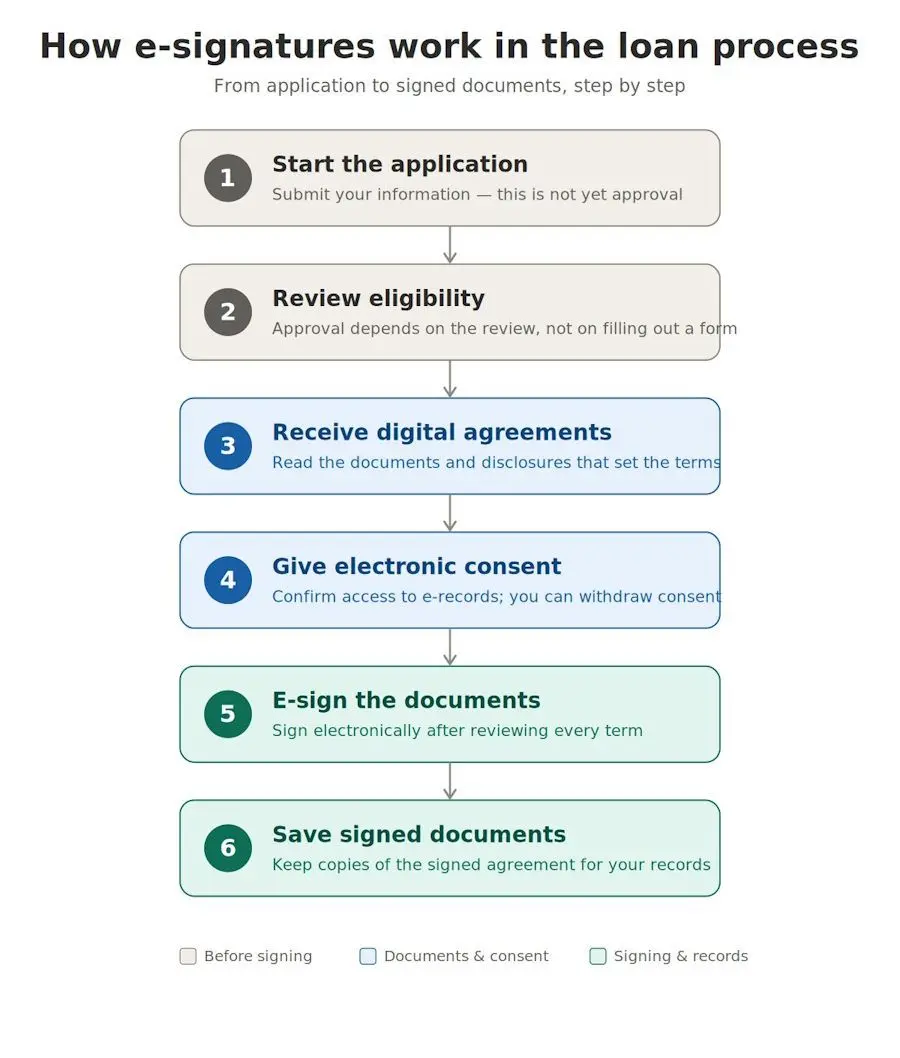
Flowchart of the six-step e-signature loan process: start the application, review eligibility, receive digital agreements, give electronic consent, e-sign the documents, and save-signed copies.
The online loan process usually follows a clear set of steps. Here is how e-signing fits in.
- Start the online application. The borrower submits the required information. Submitting an application does not mean approval.
- Review eligibility and loan details. CreditCube reviews the information according to its process. Approval depends on that review, not on filling out a form.
- Receive digital loan agreements. The borrower is presented with documents and disclosures to read. These digital loan agreements set out the terms.
- Give electronic consent. The borrower confirms they can access electronic records. The e-consent disclosure may explain paper copies and how to withdraw consent.
- E-sign loan documents. The borrower signs electronically after reviewing every term.
- Save or access signed documents. The borrower should keep copies for their records.
What Is Included in Digital Loan Agreements?
Digital loan agreements may include the following:
- Borrower information
- Lender information
- Loan amount
- APR
- Finance charge
- Fees, if applicable
- Repayment schedule
- Payment dates
- Total repayment amount
- Late or missed-payment consequences
- Electronic consent terms
- Communication preferences
- State availability or eligibility disclosures
- Borrower acknowledgments
Your actual loan terms, including any APR, fees, and repayment figures, appear in your own agreement. Always check those exact numbers when you apply, since they depend on eligibility and state availability.
What Borrowers Should Check Before They E-Sign Loan Documents
This is one of the most important steps. Before you sign, work through this checklist:
- Do I understand the loan amount?
- Do I understand the APR and fees?
- Do I know the total cost of borrowing?
- Do I know each payment date?
- Can I afford the scheduled payments?
- What happens if I miss a payment?
- Can I access and save the documents?
- Can I request paper copies?
- How can I withdraw e-consent, if that option is available?
- Is this loan suitable for my current financial situation?
If you cannot answer one of these, pause and ask the lender before you sign.
Why E-Signing Can Make Loan Documents Easier to Review
E-signing has practical benefits when used carefully. It may offer:
- Online access from a phone or computer
- Less need to print or scan
- A faster document review process
- Clearer record access
- The ability to save signed copies
- A more convenient application flow
These are convenience benefits. E-signing does not change the cost of the loan or your duty to repay it. An installment loan is an expensive form of borrowing, and the electronic format does not reduce that.
CreditCube and Digital Loan Agreements
CreditCube offers tribal installment loans for eligible borrowers. These loans carry high APRs, between 200% and 700%. As part of the online process, borrowers may be asked to review and e-sign loan documents electronically. These digital loan agreements explain the loan terms, repayment responsibilities, disclosures, and borrower acknowledgments.
Approval, availability, loan amount, costs, repayment terms, and funding timing depend on eligibility, state availability, bank processing, and the final agreement.
CreditCube does not serve every state, so availability depends on where you live. Read the full agreement carefully and review it responsibly before you sign. If you are exploring options, our overview of short term personal loans explains how this type of borrowing works.
E-Sign Loan Documents vs. Paper Loan Documents
Both formats carry the same duty: read every term before you sign. The table below compares them.
| Feature | E-signed loan documents | Paper loan documents |
|---|---|---|
| Signing method | Signed electronically | Signed by hand |
| Access | Usually available online | Usually printed or mailed |
| Storage | Can often be saved digitally | Must be stored physically |
| Review process | Can be completed from a device | May require printing, mailing, or in-person steps |
| Legal effect | May be legally valid when requirements are met | Traditionally accepted written format |
| Borrower responsibility | Read all terms before signing | Read all terms before signing |
Neither format is automatically better. The right choice depends on your needs and how you prefer to access records.
Common Mistakes to Avoid Before-signing Online
Watch out for these common errors:
- Signing without reading the full agreement
- Ignoring the APR, fees, or total repayment amount
- Assuming online-signing means approval is guaranteed
- Not saving a copy of the agreement
- Not checking payment dates
- Not understanding missed payment consequences
- Confusing electronic consent with loan approval
When You Should Pause Before Signing
Give yourself time to stop and think. Pause before signing if:
- You do not understand the repayment schedule.
- You cannot afford the payments.
- You are unsure about the total cost.
- You feel rushed.
- You cannot access or save the electronic records.
- You need clarification about any term.
- The loan would create more financial pressure.
Material terms and consequences are there for a reason. They should never be hidden or brushed aside, and neither should your questions.
Alternatives to Signing a Loan Agreement Right Away
And if you do decide to wait, you still have room to move. A loan is one option, not the only one. Before you sign, you might consider the following:
- Review your budget first. Write down your income and your fixed monthly costs, then see what is left over. If the scheduled payments would not fit that gap, waiting gives you time to adjust or look at other options.
- Ask the lender questions about the terms. Lenders expect questions, and asking them costs nothing. Ask about the payment dates, what happens if a payment is late, and how the total cost is calculated.
- Request clarification on anything unclear. If a clause is confusing, ask for it in plain language before you sign. A term you do not understand is still binding once the agreement is signed.
- Consider payment plans with service providers. Many utility companies, medical offices, and landlords offer payment arrangements. Contact them directly to ask what terms they can offer, since these vary by provider.
- Consider using savings if you have them. Drawing on savings avoids added borrowing costs. Weigh this against the reason you set the money aside and whether you can rebuild the balance.
- Consider nonprofit financial counseling for ongoing debt issues. If debt is a recurring problem rather than a one-time gap, a counselor can help you map out a longer-term plan. Confirm the counselor's services, fees, and credentials before you commit.
- Check whether the expense can wait. Some costs are urgent and some are not. Delaying a non-essential purchase by a few weeks may remove the need to borrow at all.
- Compare other borrowing options. Credit unions, employers, and other lenders may offer different products. Always confirm the specific terms and conditions of any alternative directly with that provider, since rates and requirements differ.
FAQ - E-Sign Loan Documents
Can I e-sign loan documents online?
Yes. Many lenders allow borrowers to e-sign loan documents online, subject to applicable law, consumer consent, lender requirements, and the specific loan process.
Are digital loan agreements legally binding?
Digital loan agreements may be legally binding when electronic signature and consumer consent requirements are met. Treat them as seriously as paper agreements.
What should I check before signing loan documents online?
Check the APR, fees, total repayment amount, payment schedule, due dates, missed-payment consequences, and whether repayment fits your budget.
Does e-signing mean my loan is approved?
No. E-signing does not automatically mean approval unless the lender clearly states that all approval conditions have been met. Approval depends on eligibility, lender review, state availability, and the final agreement.
Can I get paper copies of digital loan agreements?
Many electronic consent processes explain whether paper copies are available, how to request them, and whether any fee applies. Review the e-consent disclosure before signing.
Is e-signing safer than signing paper loan documents?
E-signing can be convenient and may provide digital records. Even so, you still need to verify the lender, review all terms, save copies, and understand your repayment obligations.
Can I withdraw consent to electronic documents?
Some electronic consent disclosures explain how to withdraw consent and what happens after you do. Review those terms before you agree to electronic records.
Recent Articles
Emergency Loan for Bad Credit: Fast Options & Key Tips
Emergency loan for bad credit options explained: types, requirements, pros, ...Personal Loans in San Jose CA: Understanding Funding Timelines
Compare personal loans San Jose CA and see what may affect funding timelines...BSA AML Compliance: How Lenders Keep Loans Safe
BSA AML compliance helps lenders monitor risk and protect borrowers. Learn h...Same Day Loan Funding Explained | ACH vs Wire Transfers
Same day loan funding explained. Learn how ACH, wire transfers, and bank pro...Loans Like My Quick Wallet: Best Alternatives in 2026
Explore fast loan apps like My Quick Wallet, with CreditCube offering the be...The Risk in Skipping a Loan Payment
The importance of meeting the agreed-upon timetable included in the signed a...Get your money today
Apply for a loan NOW!
Applying does NOT affect your FICO® Score!
Have questions?
Please call us by phone:
Credit Cube © 2026. All rights reserved
CreditCube is a Tribal enterprise, wholly owned and operated by the Big Valley Band of Pomo Indians, a federally-recognized American Indian tribe and sovereign government. Any Agreement entered into as a result of this Application shall be governed by applicable Tribal and federal law. Each aspect of communication and transaction with/on this site will be deemed to have occurred in CreditCube’s Big Valley Band of Pomo Indian Reservation offices, regardless of the location where you are accessing or viewing this site.
⚠ Please note: This is an expensive form of borrowing. CreditCube loans are designed to assist you in meeting your short-term borrowing needs and are not intended to be a long-term financial solution! Examples of emergency reasons why these loans might be used include unexpected emergencies, car repair bills, medical care, or essential travel expenses.
* Loan approvals are subject to underwriting. Approval may take longer if additional verification documents are requested. Not all loan requests are approved. CreditCube reviews your information in real-time to determine whether your information meets our lending criteria. You acknowledge that by completing and submitting the website application that you are applying for a Loan. We verify applicant information through national databases including, but not limited to, Clarity Services, Inc., a credit reporting agency, and we may pull your credit in order to determine your eligibility and ability to repay.
** Maximum loan amount is $500 for first-time customers. For returning CreditCube customers, rates may go down over time based on your CreditCube Loyalty Program status and your payment history with us. Please see our Loyalty Program page for more information.
*** Loan Applications processed and approved before 3pm EST Monday-Friday are typically funded on the next business day. Example: If your loan is processed and approved on Friday before 3pm EST, the loan will typically be funded on the following Monday. Deposit times may vary depending on your bank. Business Day means Monday through Friday excluding all federal banking holidays.
CreditCube does not lend to residents of Pennsylvania, Connecticut, Minnesota, New York, Vermont, Virginia, West Virginia, Illinois, Georgia and North Carolina. Availability of installment loans in your state is subject to change at any time with or without notice at the sole discretion of CreditCube.