Managing Debt: Why You Should Avoid Taking Out Multiple Loans at Once

Managing debt means tracking what you owe, when payments are due, how much each payment costs. It also means how debt fits into your monthly budget. It covers every type of borrowing you hold, from a credit card to business loans to a line of credit.
Managing debt can become more difficult when several loan payments overlap. Each new loan adds another due date, interest cost, and repayment schedule to keep track of. What looks like a short-term solution can leave less room in your monthly budget and make existing debt harder to manage. Some borrowers also find that more accounts mean more contact from lenders and collectors, and rules such as TCPA Loan Calls set limits on how that contact can happen.
A clearer approach starts with understanding what you already owe and how each payment affects your budget. Before taking out another loan, it can help to review your current debts, prioritize repayments, and consider alternatives that do not add another monthly obligation. This article explains the risks of managing multiple loans and practical ways to reduce financial pressure without taking on more debt.
How to Build a Budget for Debt Repayment?
A realistic budget shows how much you can put toward debt without falling behind on essential expenses. A common starting point is monthly take-home income, followed by fixed costs such as housing, utilities, food, transportation, insurance, and minimum debt payments.
One option is the 50/30/20 rule. It generally divides after-tax income into 50% for needs, 30% for wants, and 20% for savings and debt repayment. These percentages are a starting point, not a requirement. If minimum debt payments already take up a large share of your income, your budget may need different proportions.
Another option is zero-based budgeting, where every dollar of monthly income is assigned to a specific purpose. After covering essential expenses and required payments, any remaining amount can go toward extra debt repayment.
Whichever method you use, leaving some room for unexpected expenses can help. A repayment budget that is too strict can be difficult to maintain and may lead to new borrowing when an unplanned cost comes up.
What Are Multiple Loans?
Multiple loans generally refers to having more than one active loan at the same time. Lenders and other financial institutions may each report to credit bureaus separately, so several accounts can appear on your credit report at once.
This may include installment loans, personal loans, payday loans, auto loans, BNPL plans, credit cards, or other debts. Some come from banks or credit unions, others from online lenders. The issue is not only the number of loans. It is how the total payments affect your budget.
Multiple loans can become difficult to manage when payment dates overlap, total monthly obligations rise, or one loan is used to cover another payment.
What Is Loan Stacking?
Loan stacking generally refers to taking out several loans close together, or applying for another loan while existing loans are still active.
It can happen intentionally. It can also happen because a borrower is trying to cover urgent expenses and each loan feels like the only available step at the time.
Loan stacking may increase risk for both borrowers and lenders. Borrowers face a higher total payment. Lenders have less certainty about whether repayment is realistic. Some loans use collateral, which adds another consequence if payments stop.
The risks below explain where that pressure tends to show up.
Key Loan Stacking Risks to Understand
Higher Monthly Payment Pressure
Every new loan adds a payment. Several smaller payments can look manageable one at a time. Added together, they can take a large share of monthly income. Borrowers may underestimate the total monthly burden until all the due dates arrive in the same month. Lenders often look at your debt-to-income ratio for this reason. It compares your monthly debt payments with your monthly income.
Overlapping Due Dates
Multiple loans can have different due dates across the month. One may fall on the 3rd, another on the 12th, another on the 25th. This makes missed payments more likely. Tracking due dates becomes harder without a clear written plan.
Higher Total Cost of Borrowing
Each loan may include interest and fees. The terms differ from lender to lender. Taking multiple loans may increase your total repayment costs, even when each individual payment looks small. Check the total repayment amount for each debt, not just the payment size.
Missed Payment Consequences
Missed payments may lead to fees, collection activity, account restrictions, or credit impact. What happens depends on the lender and your specific loan agreement. Non-payment has consequences. Review your agreement so you know what applies to your accounts. If a debt goes into default, the effects can last well beyond the missed payment itself.
Borrowing to Repay Borrowing
Using one loan to pay another can become a cycle. Each round may add costs without reducing what you owe. This is a warning sign, not a solution. If this pattern is ongoing, review your alternatives and consider seeking qualified help.
Why Taking Out Multiple Loans at Once Can Make Debt Harder to Manage
| Problem | Why it makes managing debt harder |
|---|---|
| Several payment dates | Easier to forget or miss one |
| Different lender terms | Harder to compare costs and obligations |
| Higher monthly total | Less money left for essentials |
| More fees and interests | Higher total repayment amount |
| Borrowing to cover payments | Can signal deeper budget pressure |
Warning Signs You May Want to Pause Before Taking Another Loan
Consider waiting if any of these apply:
- You are unsure how you will repay the new loan.
- You are already late on existing payments.
- You need another loan to pay an existing loan.
- Your essential expenses are already difficult to cover.
- You do not know the full cost of your current debts.
- You have not reviewed alternatives.
- The new loan would create overlapping due dates you cannot manage.
- You feel pressured to borrow quickly.
None of these means borrowing is always wrong. They mean it is worth pausing to check the numbers first.
Checking the numbers does not take long. The steps below walk through what to review before you decide.
What to Do Before Applying for Another Loan
- List all current debts. For each one, write down the lender name, balance, payment amount, due date, interest or fees if known, and what happens if you miss a payment. Your credit report can help you confirm accounts you may have forgotten. Reviewing it also helps you spot signs of fraud or identity theft, such as accounts you did not open.
- Calculate your total monthly debt payment. Add all current loan payments together. Compare this amount with your monthly income and essential expenses.
- Check whether another payment fits your budget. Include rent, utilities, food, insurance, transportation, and other essentials before deciding what is left.
- Review the total repayment amount. Look beyond the payment amount. Check the total cost of each loan before signing.
- Compare alternatives. These may include payment plans, budget adjustments, creditor negotiation, nonprofit credit counseling, or emergency savings if you have them.
- Avoid borrowing under pressure. Take time to read the agreement. Ask questions before signing.
15-Minute Monthly Debt Review
Once a month, take 15 minutes to review your budget and debt:
- Verify your net pay. Check how much income actually reached your account this month.
- Update your debt balances. Record current balances, minimum payments, and upcoming due dates.
- Scan for spending leaks. Look for subscriptions, fees, dining out, or other flexible expenses you could reduce.
- Check upcoming expenses. Note bills or essential costs that may affect how much you can put toward debt.
- Review your progress. Compare your balances with last month and decide whether your repayment plan needs to change.
Your credit scores may also affect which options are available to you. If you want context on where a given score sits, see is 600 a good credit score.
Now, not every situation requires taking out multiple loans. Let’s review some of the alternatives to loans that you should consider beforehand.
Alternatives to Taking Out Multiple Loans
Separating Needs From Wants
Needs are expenses you generally cannot avoid, such as housing, basic food, utilities, transportation, and required debt payments. Wants are expenses that can often be reduced or paused, such as streaming subscriptions, dining out, entertainment, or non-essential shopping. Reviewing these categories can reveal expenses that feel necessary but are actually flexible. Temporarily cutting some wants may free up money for existing debt and reduce the need to take out another loan.
Payment Plans With Service Providers
Some medical offices, utility providers, repair shops, or other service providers may offer payment arrangements. Terms vary, so ask what is available before assuming a loan is the only route.
Budget Adjustments
Temporary reductions in non-essential spending may free up enough cash flow to avoid another loan. This will not work in every situation, but it costs nothing to check.
Contacting Current Lenders
Some lenders may have hardship options or payment arrangements. Approval is not certain, and each lender sets its own policy. Contact them early rather than after a payment is missed.
Nonprofit Credit Counseling
Credit counseling can help when debt is ongoing or difficult to manage on your own. The Consumer Financial Protection Bureau explains how to find a credit counselor and what questions to ask. Confirm any organization's services, costs, and terms directly with them before signing up.
Debt Snowball or Debt Avalanche Method
The snowball method focuses on paying smaller balances first. Paying off accounts sooner can create a sense of progress and help you stay motivated. The avalanche method focuses on higher-interest debt first. It prioritizes mathematical efficiency by reducing the debt that costs you the most in interest. Neither is automatically better. The best fit depends on your goals, your balances, and what keeps you making payments consistently.
Debt Consolidation
Debt consolidation may combine several debts into one payment. This can simplify tracking for some borrowers.
It may not reduce your total cost. Fees, interest, and a longer repayment period can offset the benefit of a single payment.
It can also be risky if you continue taking on new debt after consolidating. Compare the total cost and terms of any consolidation option against what you owe now.
How CreditCube Fits Into Responsible Borrowing?
CreditCube offers tribal installment loans for eligible borrowers. This is an expensive form of borrowing, and it is just one option among several rather than a fix for ongoing debt problems. APRs for this form of borrowing range between 200% and 700%. If you are already managing debt or have multiple loans, carefully review whether another loan payment fits your budget before applying.
CreditCube is not a guaranteed solution to debt problems, and approval is not guaranteed. Availability, loan amount, costs, repayment terms, and funding timing depend on eligibility, state availability, lender review, bank processing, and the final loan agreement. CreditCube loans are not available in every state.
CreditCube installment loans are one option among several. Review the rates and terms in full before deciding whether this form of borrowing fits your situation.
Responsible Borrowing Checklist
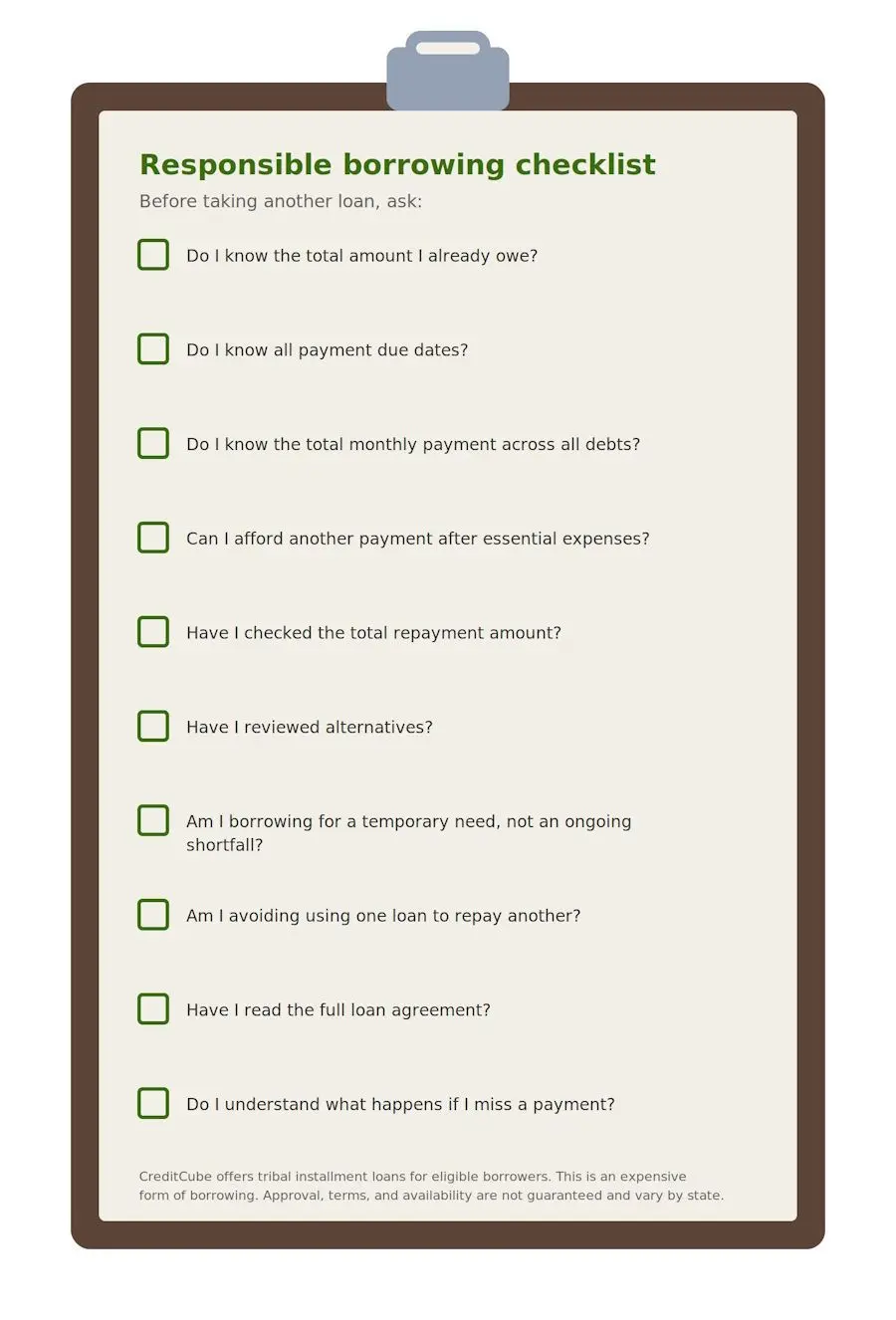
Conclusion
Managing debt starts with knowing what you owe, what it costs, and when it is due. Multiple loans make each of those harder to track, and loan stacking risks build as payments overlap. Before applying for another loan, list your debts, add up your total monthly payment, and check the alternatives. If the numbers do not work, another loan is unlikely to make them work.
CreditCube installment loans are one of several options for eligible borrowers. Their costs and terms should be reviewed in full before any decision to borrow.
FAQs about Managing debt
What is the best way to start managing debt?
Start by listing every debt, payment amount, due date, and lender. Then compare your total monthly debt payments with your income and essential expenses. This helps you see whether your current debt is manageable before considering another loan.
Is it bad to have multiple loans at once?
Having multiple loans is not automatically bad, but it can increase repayment pressure. The risk depends on your income, payment schedule, total cost, due dates, and whether you can make every payment on time.
What are loan stacking risks?
Loan stacking risks include overlapping due dates, higher total monthly payments, missed payments, additional fees, collection activity, and long-term financial pressure. The risk increases when borrowers use one loan to repay another.
Can I take out another loan if I already have debt?
It depends on your budget, eligibility, existing repayment obligations, and whether the new loan fits your financial situation. Before applying, review the total cost, repayment schedule, alternatives, and whether borrowing could make your debt harder to manage.
What should I do if I already have multiple loans?
List all debts, organize due dates, calculate total monthly payments, contact lenders if you are struggling, consider payment plans or credit counseling, and avoid taking another loan unless repayment is realistic.
Is debt consolidation better than taking multiple loans?
Debt consolidation may simplify payments in some situations, but it is not always the best option. It may involve fees, interest, eligibility requirements, and potential risks. Borrowers should compare total cost and terms before choosing this path.
Recent Articles
Vacation Loans: Rates, Terms, and How They Work
Vacation loans explained: compare rates, terms, and lenders to plan your tri...$500 Payday Loans Online Same Day - Fast Cash Guide
$500 payday loans online same day explained. Learn how they work, requiremen...Cash Advance App Fees: What They Really Cost
Cash advance app fees can hide more than one charge. Learn the full cost, re...$255 Payday Loans Online Same Day | Instant Debit Card Funding
$255 payday loan instant funding to debit card options explained. Learn how ...GLBA Privacy Rules: What Borrowers Need to Know
GLBA privacy rules, explained: what the Gramm-Leach-Bliley Act requires and ...Native American Installment Loans for Bad Credit Guide
Native American installment loans for bad credit, explained: how they work, ...Get your money today
Apply for a loan NOW!
Applying does NOT affect your FICO® Score!
Have questions?
Please call us by phone:
Credit Cube © 2026. All rights reserved
CreditCube is a Tribal enterprise, wholly owned and operated by the Big Valley Band of Pomo Indians, a federally-recognized American Indian tribe and sovereign government. Any Agreement entered into as a result of this Application shall be governed by applicable Tribal and federal law. Each aspect of communication and transaction with/on this site will be deemed to have occurred in CreditCube’s Big Valley Band of Pomo Indian Reservation offices, regardless of the location where you are accessing or viewing this site.
⚠ Please note: This is an expensive form of borrowing. CreditCube loans are designed to assist you in meeting your short-term borrowing needs and are not intended to be a long-term financial solution! Examples of emergency reasons why these loans might be used include unexpected emergencies, car repair bills, medical care, or essential travel expenses.
* Loan approvals are subject to underwriting. Approval may take longer if additional verification documents are requested. Not all loan requests are approved. CreditCube reviews your information in real-time to determine whether your information meets our lending criteria. You acknowledge that by completing and submitting the website application that you are applying for a Loan. We verify applicant information through national databases including, but not limited to, Clarity Services, Inc., a credit reporting agency, and we may pull your credit in order to determine your eligibility and ability to repay.
** Maximum loan amount is $500 for first-time customers. For returning CreditCube customers, rates may go down over time based on your CreditCube Loyalty Program status and your payment history with us. Please see our Loyalty Program page for more information.
*** Loan Applications processed and approved before 3pm EST Monday-Friday are typically funded on the next business day. Example: If your loan is processed and approved on Friday before 3pm EST, the loan will typically be funded on the following Monday. Deposit times may vary depending on your bank. Business Day means Monday through Friday excluding all federal banking holidays.
CreditCube does not lend to residents of Pennsylvania, Connecticut, Minnesota, New York, Vermont, Virginia, West Virginia, Illinois, Georgia and North Carolina. Availability of installment loans in your state is subject to change at any time with or without notice at the sole discretion of CreditCube.