Gramm-Leach-Bliley Act (GLBA) and Your Financial Privacy: Rules and Requirements

The Gramm-Leach-Bliley Act (GLBA) is the federal law that governs how financial companies handle personal information, and the Federal Trade Commission helps enforce it. It applies to many businesses that offer financial products or services, from banks to online lenders. When you apply for a loan, you hand over a lot of personal details. In plain terms, it sets rules for how your consumer financial information is collected, shared, and protected.
GLBA covers privacy notices, information sharing, opt-out rights, and data safeguards. In this guide, we explain the main Gramm-Leach-Bliley Act requirements. You will learn what the law protects, what choices you have, and what to check before you share sensitive details. This is general information, not legal advice.
What Do GLBA Privacy Rules Cover?
GLBA privacy rules focus on how companies handle your financial information. They cover a few main areas, summed up in the table below.
| GLBA area | What it means for you |
|---|---|
| Privacy notice | Explains what information is collected, shared, and protected |
| Opt-out rights | May let you limit certain third-party sharing |
| Safeguards | Require covered institutions to protect your information |
| Redisclosure limits | Restrict how shared information may be reused |
| Account number limits | Restrict sharing account access numbers for marketing |
Each area ties back to one goal: keeping you informed about your own data.
What Consumer Financial Information Is Protected?
Consumer financial information is the personal and financial detail a company collects when you seek a financial product or service. Under GLBA, this is often called nonpublic personal information. It is the data tied to your relationship with a lender. That information may include several things you share or a lender gathers:
- Loan application details. The information you enter when you apply.
- Identity details. Your name, address, income, and Social Security number.
- Account information. Your account numbers and balances.
- Payment history. A record of what you have paid and when.
- Loan balances. The amount you still owe.
- Consumer report information. Data from your credit file, including during a soft credit check loans review.
- Transaction information. Details gathered during a financial transaction.
Not all public information is treated the same way. Still, data tied to your lender-customer relationship may stay protected even when part of it looks public. Here is how this plays out when you borrow.
GLBA Loan Privacy: What Borrowers Should Know
A loan application asks for sensitive personal and financial details. Even a fast option like quick loans involves sharing this information. GLBA loan privacy rules shape how a covered lender handles it.
A lender may use your information for several permitted reasons. These include reviewing your eligibility, processing the transaction, servicing your account, preventing fraud, complying with the law, and staying in touch with you. Reading the privacy notice before you submit anything is a must.
Privacy rules do not mean your information is never shared. They explain when and how sharing may happen. A lender's own privacy notice spells out its specific practices, so that notice is always the place to look. Next, here are the law's core requirements.
What Are the Main Gramm-Leach-Bliley Act Requirements?
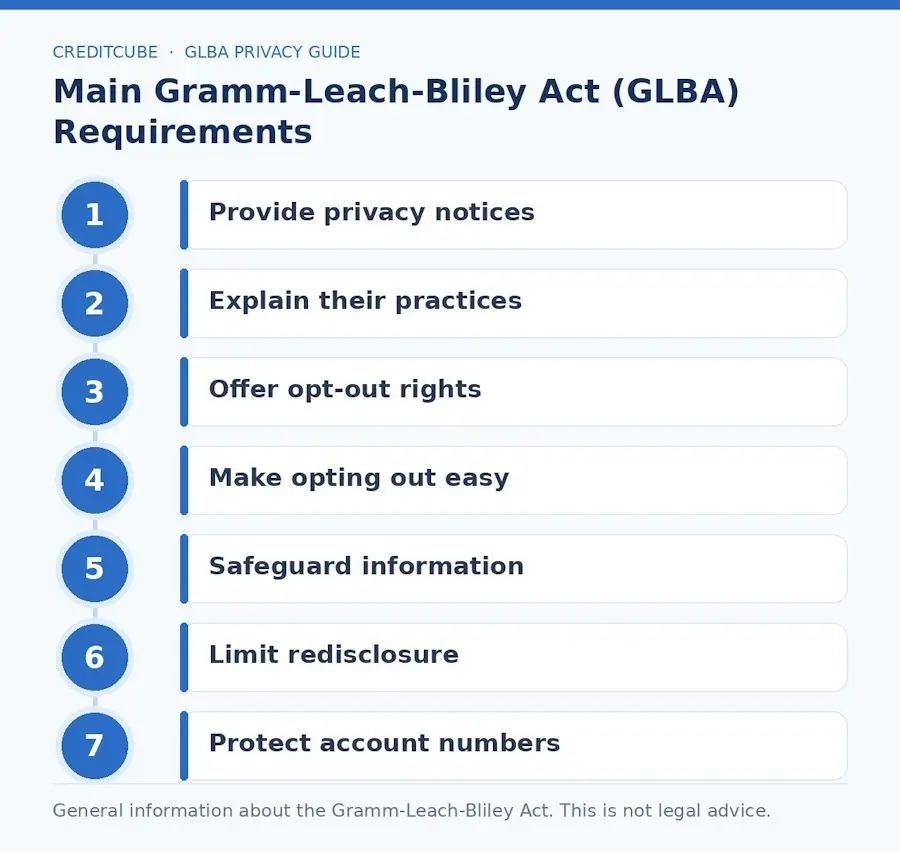
The law sets out a handful of core duties for covered companies. These are the main Gramm-Leach-Bliley Act requirements:
- Provide privacy notices. Covered financial institutions generally must provide an initial notice when establishing a customer relationship and annual notices while that relationship continues, unless an exception applies. Applicants who do not become customers may also be entitled to a notice, depending on how their information is shared.
- Explain their practices. The notice must describe how information is collected, disclosed, and protected.
- Offer opt-out rights. Customers may have the right to opt out of certain sharing with nonaffiliated third parties.
- Make opting out easy. When opt-out rights apply, the company must give a reasonable way to use them.
- Safeguard information. Customer information must be protected with appropriate safeguards.
- Limit redisclosure. The reuse and redisclosure of nonpublic personal information is restricted.
- Protect account numbers. Account numbers and access codes have special limits for marketing use.
Together, these duties give you both information and some control. The privacy notice is where most of them show up, so it is worth a closer look.
Privacy Notices: What They Usually Explain
A privacy notice is where a company lays out its information practices. When you read one, you can usually expect it to explain:
- What is collected. The categories of information the company gathers.
- What is shared. The categories it may disclose.
- Who receives it. The affiliates or third parties that may get your information.
- Your choices. Whether you can opt out of certain sharing.
- How it is protected. The steps taken to keep your information secure.
- How to reach them. A way to contact the company about privacy.
A clear notice answers these without making you hunt. Let’s take a closer look at what “your choices” means.
What Does "Opt Out" Mean Under GLBA?
To opt out means to tell a company not to share certain information. Under GLBA, this may apply to some sharing of nonpublic personal information with nonaffiliated third parties. It puts a measure of control in your hands.
Certain service-provider and joint-marketing disclosures may also be exempt from GLBA opt-out requirements when the required notice and contractual protections are in place. Other applicable laws may provide additional rights.
Opt-out rights do not cover every kind of sharing, though. A company may still share some information to process your transaction, service your account, prevent fraud, or follow the law. For example, a lender can share data with a payment processor to handle your payment. To see your choices, read the privacy notice. Up next is a rule people often confuse with these privacy rules.
GLBA Privacy Rules vs. Safeguards Rule
People often mix up the privacy rules and the Safeguards Rule. They work together, but they focus on different things.
| Topic | Main focus |
|---|---|
| GLBA privacy rules | Notices, information sharing, opt-out rights, and disclosure limits |
| Safeguards Rule | Security measures that protect customer information |
| Regulation P | The CFPB rule that implements privacy notice and disclosure requirements |
The safeguards rule calls for administrative, technical, and physical protections. The privacy rules focus on what you are told and what you can limit.
Why Does GLBA Matter When Applying for a Loan?
A loan application can hold some of your most sensitive data. Whether you choose a bank or quick personal loans online, it helps to know how that data may be handled. GLBA gives you a window into those practices. The law does not block all sharing. What it does is require disclosure and set limits. The privacy notice is your guide to both. Before you submit anything, use a secure application channel and read the notice in full. Here is a simple way to do that.
Checklist: Reviewing a Financial Privacy Notice
A privacy notice is worth a few minutes before you apply. Run through these questions as you read.
- What is collected? Note the information the company gathers.
- Affiliate sharing? Check whether it shares with affiliates.
- Third-party sharing? See whether it shares with nonaffiliated third parties.
- Can you opt out? Look for your right to limit certain sharing.
- How do you opt out? Find the steps to exercise that right.
- How is it protected? Read how the company secures your information.
- Any changes? Check how you will be told if practices change.
- Clear contact? Make sure there is a way to ask questions.
If a notice leaves any of these unanswered, that is worth a question before you apply. A few everyday habits round out your privacy protection.
Responsible Borrower Privacy Tips
A few habits go a long way toward protecting your financial privacy. Keep these in mind before and after you apply.
- Read the privacy notice first. Know the practices before you share anything.
- Use secure websites. Look for a secure connection before you enter details.
- Avoid unsecured channels. Do not send sensitive information by unsecured email or text.
- Check sharing practices. See how the company uses and shares your information.
- Save important notices. Keep copies of the notices you receive.
- Review opt-out options. Use them where they are available.
For GLBA privacy purposes, nonpublic personal information generally includes personally identifiable financial information obtained in connection with a financial product or service sought or obtained primarily for personal, family, or household use. Publicly available information is generally excluded, although lists or groupings derived using protected information may remain covered.
Conclusion
GLBA privacy rules help you understand how financial companies collect, share, and protect your information. The main Gramm-Leach-Bliley Act requirements include privacy notices, opt-out rights for certain sharing, limits on redisclosure and reuse, and safeguards for your data. Before you submit sensitive loan information, read the privacy notice and use a secure channel. The law gives you disclosure and some choices, so put them to use. A lender’s privacy notice explains its stated practices, but those practices must comply with applicable law. Additional rights or restrictions may apply under other federal or state laws.
FAQs About GLBA Privacy Rules
What are GLBA privacy rules?
GLBA privacy rules are federal financial privacy requirements that apply to many financial institutions. They generally require covered companies to explain how they collect, share, and protect your consumer financial information.
What are the main Gramm-Leach-Bliley Act requirements?
Gramm-Leach-Bliley Act requirements include privacy notices, disclosures about information sharing, opt-out rights for certain third-party sharing, limits on redisclosure and reuse, and safeguards for customer information.
What is consumer financial information?
For GLBA privacy purposes, nonpublic personal information generally includes personally identifiable financial information obtained in connection with a financial product or service sought or obtained primarily for personal, family, or household use. Publicly available information is generally excluded, although lists or groupings derived using protected information may remain covered. Examples include loan application data, income information, account information, payment history, and consumer report information.
What does GLBA loan privacy mean for borrowers?
GLBA loan privacy shapes how covered lenders explain their information practices, how some of your information may be shared, and what choices you may have about certain disclosures.
Does GLBA stop lenders from sharing my information?
Not always. GLBA limits and regulates certain sharing, but some sharing is allowed to process transactions, service accounts, prevent fraud, or comply with the law.
What should I look for in a financial privacy notice?
Look for what information is collected, who it may be shared with, whether you can opt out, how to opt out, and how the company protects your information.
Is the Safeguards Rule the same as GLBA privacy rules?
No. The privacy rules focus on notices, information sharing, and opt-out rights. The Safeguards Rule focuses on protecting customer information through security measures.
Recent Articles
Installment Loans vs Payday Loans: Which Is Safer and Smarter in 2026
Compare installment loans vs payday loans in 2026 explore risks, benefits, r...Loan With 500 Credit Score: Approval Options
Loan with 500 credit score options explained. Learn how to qualify faster, w...Home Improvement Loans With Bad Credit: 2026 Guide
Home improvement loans with bad credit explained. Learn options, rates, and ...Electronic Funds Transfer Act: EFTA Rules for Borrowers
EFTA regulations set rules for automatic loan payments and electronic transf...Personal Loan Hialeah FL: Funding Timelines Explained
Getting a personal loan in Hialeah, FL? Learn what affects funding timelines...Loan Application Process: What Happens After You Submit
The loan application process doesn't end at submit. See the review timeline,...Get your money today
Apply for a loan NOW!
Applying does NOT affect your FICO® Score!
Have questions?
Please call us by phone:
Credit Cube © 2026. All rights reserved
CreditCube is a Tribal enterprise, wholly owned and operated by the Big Valley Band of Pomo Indians, a federally-recognized American Indian tribe and sovereign government. Any Agreement entered into as a result of this Application shall be governed by applicable Tribal and federal law. Each aspect of communication and transaction with/on this site will be deemed to have occurred in CreditCube’s Big Valley Band of Pomo Indian Reservation offices, regardless of the location where you are accessing or viewing this site.
⚠ Please note: This is an expensive form of borrowing. CreditCube loans are designed to assist you in meeting your short-term borrowing needs and are not intended to be a long-term financial solution! Examples of emergency reasons why these loans might be used include unexpected emergencies, car repair bills, medical care, or essential travel expenses.
* Loan approvals are subject to underwriting. Approval may take longer if additional verification documents are requested. Not all loan requests are approved. CreditCube reviews your information in real-time to determine whether your information meets our lending criteria. You acknowledge that by completing and submitting the website application that you are applying for a Loan. We verify applicant information through national databases including, but not limited to, Clarity Services, Inc., a credit reporting agency, and we may pull your credit in order to determine your eligibility and ability to repay.
** Maximum loan amount is $500 for first-time customers. For returning CreditCube customers, rates may go down over time based on your CreditCube Loyalty Program status and your payment history with us. Please see our Loyalty Program page for more information.
*** Loan Applications processed and approved before 3pm EST Monday-Friday are typically funded on the next business day. Example: If your loan is processed and approved on Friday before 3pm EST, the loan will typically be funded on the following Monday. Deposit times may vary depending on your bank. Business Day means Monday through Friday excluding all federal banking holidays.
CreditCube does not lend to residents of Pennsylvania, Connecticut, Minnesota, New York, Vermont, Virginia, West Virginia, Illinois, Georgia and North Carolina. Availability of installment loans in your state is subject to change at any time with or without notice at the sole discretion of CreditCube.