Understanding the Electronic Funds Transfer Act (EFTA)
The Electronic Funds Transfer Act, known as EFTA, sets consumer rights and financial institution duties for electronic fund transfers. These rules can matter to anyone who sets up automatic loan payments. When a loan payment is scheduled as a recurring debit from a bank account, EFTA regulations may shape how that transfer is authorized and handled. Regulation E is the rule that puts EFTA into practice. It covers how transfers are authorized, how errors are resolved, and what rights a customer has to stop a preauthorized payment. If you use installment loans for bad credit or any product with recurring debits, these basics are worth knowing. This article is general education. It is not legal advice. It is not legal advice, and this content is informational and does not constitute an offer of credit. For your own situation, check your loan agreement and contact your lender or bank.
What Are EFTA Regulations?
EFTA stands for Electronic Fund Transfer Act. Regulation E implements the Act and spells out the details. Together, they set a framework of rights and responsibilities for electronic transfers.
The rules cover many transfers that debit or credit a consumer account. Examples may include:
- ACH transfers
- Debit card payments
- Direct deposits
- Direct withdrawals
- ATM transfers
- Certain online bill payments
A few points help set expectations. EFTA regulations are not loan pricing rules. They do not erase debt or cancel a loan obligation. Instead, they focus on how electronic transfers are authorized, how errors get fixed, who is liable, and what procedures apply.
How EFTA Regulations Apply to Automatic Loan Payments
Automatic loan payments often work as recurring electronic debits from a borrower's bank account. These may be ACH payments, debit card payments, or other electronic transfers. When a payment is preauthorized and recurring, Regulation E rules may apply.
A borrower should receive clear authorization terms before payments start. Those terms should cover the payment amount, the timing, the payment method, and how to revoke authorization.
Automatic loan payments can help you schedule repayment. Still, you should understand them before you authorize anything. EFTA regulations focus on how electronic transfers are authorized, how errors are handled, and what rights you have when you want to stop preauthorized payments.
What Counts as a Preauthorized Electronic Fund Transfer?
A preauthorized transfer is set up in advance to happen later. For loan repayment, this often means recurring debits on scheduled due dates.
It helps to tell these apart:
- One-time online payment
- Recurring automatic loan payments
- Debit card payment
- ACH authorization
- Check conversion
- Manual payment after you receive an invoice
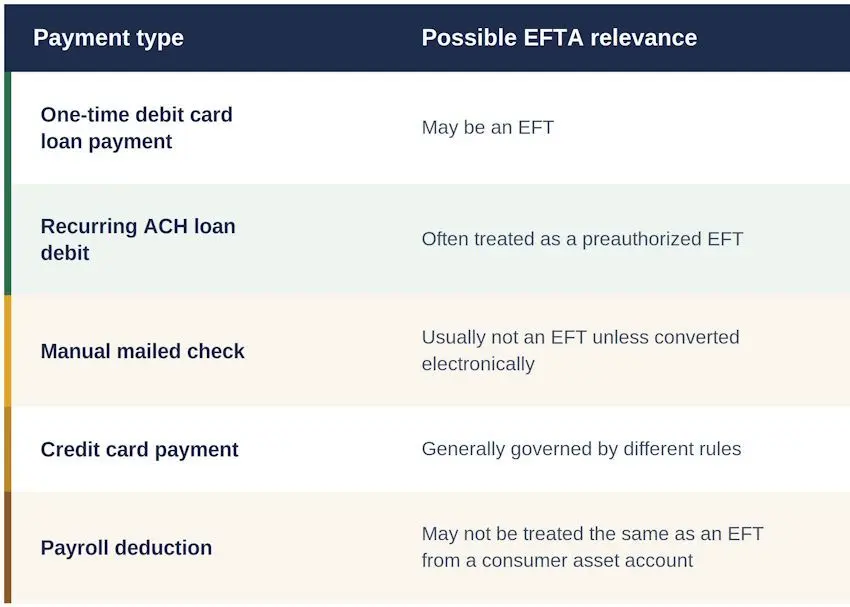
The table below shows how different payment types may relate to EFTA. Treat it as general guidance, not a ruling on any single case.
Authorization Rules for Automatic Loan Payments
Preauthorized EFTs from a consumer account generally require written or similarly authenticated authorization. Electronic signatures may be acceptable when they are obtained properly. The consumer should receive a copy of the authorization, and the terms should be clear.
Before automatic loan payments begin, you should understand what you are authorizing. The authorization should explain who may debit the account, when payments may happen, how much may be taken, and how you can keep a record of it all. If any of this is unclear, ask before you sign.
Can a Lender Require Automatic Loan Payments?
This is one of the most important points. For most consumer credit, lenders generally cannot require repayment by preauthorized electronic fund transfer as a condition of credit, although they may require repayment by another method.
A lender may offer automatic loan payments as one option. In some cases, a creditor may offer an incentive for automatic payments when another repayment method is also available. Whether any given incentive applies depends on the offer and the agreement, so review the terms.
Before you agree, check whether other repayment methods are available and read what the loan agreement says. You should not feel that autopay is your only path to approval.
What If the Payment Amount Changes?
Sometimes a preauthorized payment amount changes from one period to the next. When a preauthorized EFT will differ from the previous amount or the authorized amount, advance written notice — typically at least 10 days before the transfer — may be required, unless you authorized a range of amounts in advance. Watch your account statements and any loan messages so a change does not surprise you.
Amounts may change for several reasons. Here are generic examples:
- A payment changes because of a fee
- A payment changes after an early payoff
- A payment changes under a revised schedule
- A payment changes after a missed payment, if that applies and is disclosed These are general examples only. Your actual terms depend on your agreement.
How to Stop Automatic Loan Payments
You can usually take a few practical steps:
- Contact the lender or merchant to revoke the payment authorization, and separately notify your bank if you want a stop-payment block. In practice, revocation goes to the merchant or lender, while a stop-payment order is handled by your bank — the two are different actions and both may be needed.
- You can typically give the stop-payment order orally, but your bank may require written confirmation within 14 days after an oral order. To be effective, the order should generally be provided at least three business days before the scheduled transfer.
- Ask your bank about its stop-payment procedures.
- Keep records of dates, emails, letters, and confirmation numbers.
- Monitor the account after the change.
- Use another approved repayment method if the loan payment is still due.
One thing to keep in mind: stopping automatic loan payments does not cancel the loan. It only changes or stops the electronic debit authorization. You may still need to pay using another method under the loan agreement.
Does Canceling Automatic Loan Payments Cancel the Loan?
No. Canceling automatic loan payments does not cancel the debt. You may still owe your scheduled payments, and missing them may have consequences. Canceling an automatic payment only affects the payment method. It does not remove your repayment obligation. If a loan payment is still due, use another accepted payment method or contact the lender before the due date. If you expect trouble paying, reach out early rather than late.
If you are canceling because you suspect an error in your recent charges, here is what you need to know about resolving payment discrepancies.
What to Do If an Automatic Loan Payment Was Unauthorized or Incorrect
If something looks wrong, act promptly:
- Review the payment and your loan records.
- Contact the lender.
- Contact your bank or credit union.
- Report the issue quickly.
- Keep your documentation.
- Monitor future transfers.
- Ask the bank about its dispute or error-resolution procedures.
If you believe an automatic loan payment was unauthorized, incorrect, or processed after you revoked authorization, contact your bank or credit union promptly, and no later than 60 days after the statement showing the problem is sent to you. Give them the details you have, such as the date, the amount, and the company name. Reporting quickly helps protect your rights under the error-resolution process.
Borrower Checklist Before Setting Up Automatic Loan Payments
Ask yourself:
- Do I understand the payment amount?
- Do I understand the due dates?
- Do I know whether the amount can vary?
- Do I have a copy of the authorization?
- Do I know how to cancel or change automatic payments?
- Do I know what other payment methods are available?
- Can I keep enough funds in the account on the due date?
- Do I understand possible missed-payment or insufficient-funds consequences?
- Have I reviewed the loan agreement?
Lender-Facing Compliance Considerations
Lenders can support customers by keeping automatic payments clear and fair:
- Use clear authorization language.
- Provide a copy of the authorization.
- Avoid making automatic loan payments a required condition of credit.
- Explain the available payment methods.
- Give clear information when payment amounts may vary.
- Avoid misleading payment claims.
- Keep consumer-facing language simple.
- Make cancellation and stop-payment information easy to find.
- Send sensitive claims to compliance before publication.
These standards guide how we approach our own communications. For example, here is how CreditCube manages this process for our customers.
How CreditCube May Discuss Automatic Loan Payments
CreditCube is a tribal installment lender. It may provide information about available repayment methods as part of the loan process. Before you authorize automatic loan payments, review your loan agreement carefully.
Any loan amount, repayment schedule, fees, costs, payment method, and available options depend on eligibility, state availability, and the final agreement. There are also high APRs, between 200% and 700%. Because these details vary, confirm the current terms and conditions when you apply rather than relying on general descriptions.
EFTA Regulations vs. Other Consumer Finance Rules
EFTA is one of several consumer finance rules, and each covers a different area:
- EFTA / Regulation E: electronic fund transfers.
- TILA / Regulation Z: credit cost disclosures.
- FCRA: credit reporting.
- FDCPA: third-party debt collection.
- ECOA: credit discrimination.
For automatic loan payments, EFTA and Regulation E are the main rules to know. If you are also researching home improvement loans or other credit products, the other rules above may apply to those topics.
Sum Up
EFTA regulations help protect consumers who use electronic fund transfers. A few takeaways:
- Automatic loan payments should be authorized clearly.
- Borrowers may have stop-payment and error-resolution rights.
- Canceling autopay does not cancel the loan.
- Review your agreement, and contact your lender or bank when you need to change payment methods.
For the full federal rule, you can read the CFPB's Regulation E page.
FAQ about EFTA Rules
What are EFTA regulations?
EFTA regulations are consumer protection rules for electronic fund transfers. They are put into practice through Regulation E and may apply to transfers that debit or credit a consumer account.
Do EFTA regulations apply to automatic loan payments?
They may apply when automatic loan payments run through recurring electronic transfers from a consumer bank account, such as ACH debits or certain debit card payments.
Can a lender require automatic loan payments?
In general, a creditor may not require you to repay a loan through preauthorized recurring electronic transfers as a condition of credit. Review your loan agreement and the payment methods on offer.
How can I stop automatic loan payments?
You can usually start by contacting the lender to revoke authorization, then contact your bank or credit union to explain that authorization is revoked. Keep written records, and keep making required loan payments through another accepted method.
Does stopping automatic loan payments cancel my loan?
No. Stopping automatic loan payments does not cancel the loan or remove the repayment obligation. It only affects the automatic electronic payment method.
What if an automatic loan payment is wrong?
If a payment looks unauthorized, incorrect, or processed after you revoked authorization, contact your bank or credit union promptly and share details about the payment.
What should I check before authorizing automatic loan payments?
Check the payment amount, the due dates, your account information, whether the amount can vary, how to cancel authorization, what other payment methods are available, and whether the payment fits your budget.
Recent Articles
Quick Loans in 2026: How to Apply and Get Approved Fast
Quick loans guide for 2026. Learn how to apply, approval steps, requirements...Cash Advance App Fees: What They Really Cost
Cash advance app fees can hide more than one charge. Learn the full cost, re...Otter Lending Alternatives for Fast Loans
Need a quick loan? Check out the best Otter Lending alternatives like Rise C...Short Term Personal Loans: Compare Options in 2026
Short term personal loans explained with lender options, costs, and tips to ...Installment Loans for Bad Credit in 2026: Rates, Terms & Options
Installment loans for bad credit explained. Learn terms, costs, approval rul...AI Loan Approval Is Faster and You’ll Be Shocked How!
Discover how AI loan approval and automated underwriting are revolutionizing...Get your money today
Apply for a loan NOW!
Applying does NOT affect your FICO® Score!
Have questions?
Please call us by phone:
Credit Cube © 2026. All rights reserved
CreditCube is a Tribal enterprise, wholly owned and operated by the Big Valley Band of Pomo Indians, a federally-recognized American Indian tribe and sovereign government. Any Agreement entered into as a result of this Application shall be governed by applicable Tribal and federal law. Each aspect of communication and transaction with/on this site will be deemed to have occurred in CreditCube’s Big Valley Band of Pomo Indian Reservation offices, regardless of the location where you are accessing or viewing this site.
⚠ Please note: This is an expensive form of borrowing. CreditCube loans are designed to assist you in meeting your short-term borrowing needs and are not intended to be a long-term financial solution! Examples of emergency reasons why these loans might be used include unexpected emergencies, car repair bills, medical care, or essential travel expenses.
* Loan approvals are subject to underwriting. Approval may take longer if additional verification documents are requested. Not all loan requests are approved. CreditCube reviews your information in real-time to determine whether your information meets our lending criteria. You acknowledge that by completing and submitting the website application that you are applying for a Loan. We verify applicant information through national databases including, but not limited to, Clarity Services, Inc., a credit reporting agency, and we may pull your credit in order to determine your eligibility and ability to repay.
** Maximum loan amount is $500 for first-time customers. For returning CreditCube customers, rates may go down over time based on your CreditCube Loyalty Program status and your payment history with us. Please see our Loyalty Program page for more information.
*** Loan Applications processed and approved before 3pm EST Monday-Friday are typically funded on the next business day. Example: If your loan is processed and approved on Friday before 3pm EST, the loan will typically be funded on the following Monday. Deposit times may vary depending on your bank. Business Day means Monday through Friday excluding all federal banking holidays.
CreditCube does not lend to residents of Pennsylvania, Connecticut, Minnesota, New York, Vermont, Virginia, West Virginia, Illinois, Georgia and North Carolina. Availability of installment loans in your state is subject to change at any time with or without notice at the sole discretion of CreditCube.