FDCPA Guidelines: Fair Debt Collection Practices Act Explained

If a debt collector contacts you, FDCPA guidelines spell out what they may and may not do. The Fair Debt Collection Practices Act is a federal law that limits abusive, unfair, and deceptive debt collection. It protects you without erasing any debt you actually owe.
This guide explains the main rules in plain English. You will learn the communication limits, what a validation notice should include, how disputes work, and the steps to take when a notice arrives. Along the way, it points you to the federal regulators that enforce these rules.
This article is general information only, not legal advice. For help with your specific situation, consider speaking with a qualified attorney or a nonprofit credit counselor.
What Are FDCPA Guidelines?
FDCPA guidelines are the rules under the Fair Debt Collection Practices Act that set how covered debt collectors must behave. They focus on fair debt collection practices: honest communication, required disclosures, and limits on harassment and false statements. A newer rule, Regulation F, adds detailed standards for debt collection communications.
One point matters most here. These guidelines are not a way to erase a valid debt. They are consumer-protection rules for how a collector must act, and you can read the law itself in the FTC's full text of the FDCPA.
Now that the definition is clear, let us look at who the law covers.
Who Does the FDCPA Apply To?
The FDCPA applies mainly to third-party debt collectors, not usually to the original creditor. That group can include collection agencies, debt buyers, and attorneys who collect debts. It covers consumer debts taken on for personal, family, or household purposes.
Business debts generally fall outside the law. Keep in mind that your state may add protections of its own. Some state laws reach further than the federal FDCPA, so it is worth checking both.
What Counts as Fair Debt Collection Practices?
Fair debt collection practices are the honest, respectful steps a collector must follow when contacting you. In short, a collector should identify itself, tell you about the debt, and give you a way to dispute it, all while staying within legal limits on contact.
These are the practices you should expect:
- Clear identification. The collector tells you who it is.
- Required debt information. It gives you the details the law requires about the debt.
- A path to dispute. It explains how you can dispute the debt.
- Contact within limits. It reaches out only within legal times and places.
- No harassment. It avoids threats, abuse, and misleading statements.
- Respect for your attorney. It works through your lawyer when you have one for the debt.
- An opt-out option. It offers a reasonable way to opt out of certain electronic messages.
When a collector falls short of these, that may be a problem. Here is what the law flatly prohibits.
What Debt Collectors Cannot Do Under FDCPA Guidelines?
Under FDCPA guidelines, a debt collector cannot harass you, lie to you, use unfair pressure, expose your debt to others, or contact you at the wrong time or place. The table below puts each limit in plain terms.
| Prohibited conduct | Plain-English meaning |
|---|---|
| Harassment or abuse | Collectors cannot use repeated abusive contact, threats, or insulting language. |
| False or misleading statements | Collectors cannot lie about the debt, its legal status, the amount owed, or the consequences. |
| Unfair practices | Collectors cannot use unfair methods to pressure you into paying. |
| Improper third-party disclosure | Collectors generally cannot reveal your debt to other people. |
| Wrong time or place contact | Collectors generally cannot reach you at unusual or inconvenient times or places. |
| Ignoring dispute rights | Collectors must follow the applicable validation and dispute rules. |
These limits apply across every channel a collector might use.
FDCPA Communication Guidelines: Calls, Texts, Emails, and Social Media
FDCPA communication guidelines limit when and how a collector can reach you, by phone or online. As a general rule, a collector cannot contact you before 8 a.m. or after 9 p.m. in your local time. The CFPB explains these contact limits in detail.
A few more rules round this out. A collector cannot contact you at work if it knows you are not allowed to take such messages there. Under Regulation F, texts, emails, and social media messages are allowed, but a collector must give you a simple way to opt out. Public posts about your debt on social media are not allowed, though a private message is, if the sender says it is a debt collector.
Please note that this section provides general rules, not legal advice. Whether a contact breaks the law depends on specific details, so not every unwanted message is a violation.
Next, here is the information a collector owes you about the debt itself.
Debt Validation: What Information Should a Collector Provide?
A covered collector generally must provide validation information in the initial communication or send a written or electronic validation notice within five days afterward. A separate notice is not required if the required information was provided orally in the initial communication or the debt was paid before the notice was due. This notice is your starting point for checking whether the debt is real and yours.
When the notice arrives, look for these items:
- Collector name. Who is contacting you.
- Creditor name. Who the debt is owed to.
- Amount claimed. How much the collector says you owe.
- Account details. Information that ties the debt to an account.
- Dispute deadline. The window you have to dispute, generally 30 days.
- Response instructions. How to reply or dispute.
- Payment instructions may be included. Disclosures about time-barred debt may be required under other applicable law; they are not a universal FDCPA validation-notice requirement. An itemization showing the balance on a specified date and subsequent interest, fees, payments, and credits, subject to applicable exceptions; and instructions for requesting the original creditor’s name and address.
- Time-barred status. Whether the debt may be too old to sue over.
Review whether the debt looks familiar, and keep copies of every letter, email, text, and payment record. If something looks off, you have the right to dispute it.
Disputing a Debt Under FDCPA Guidelines, Step by Step
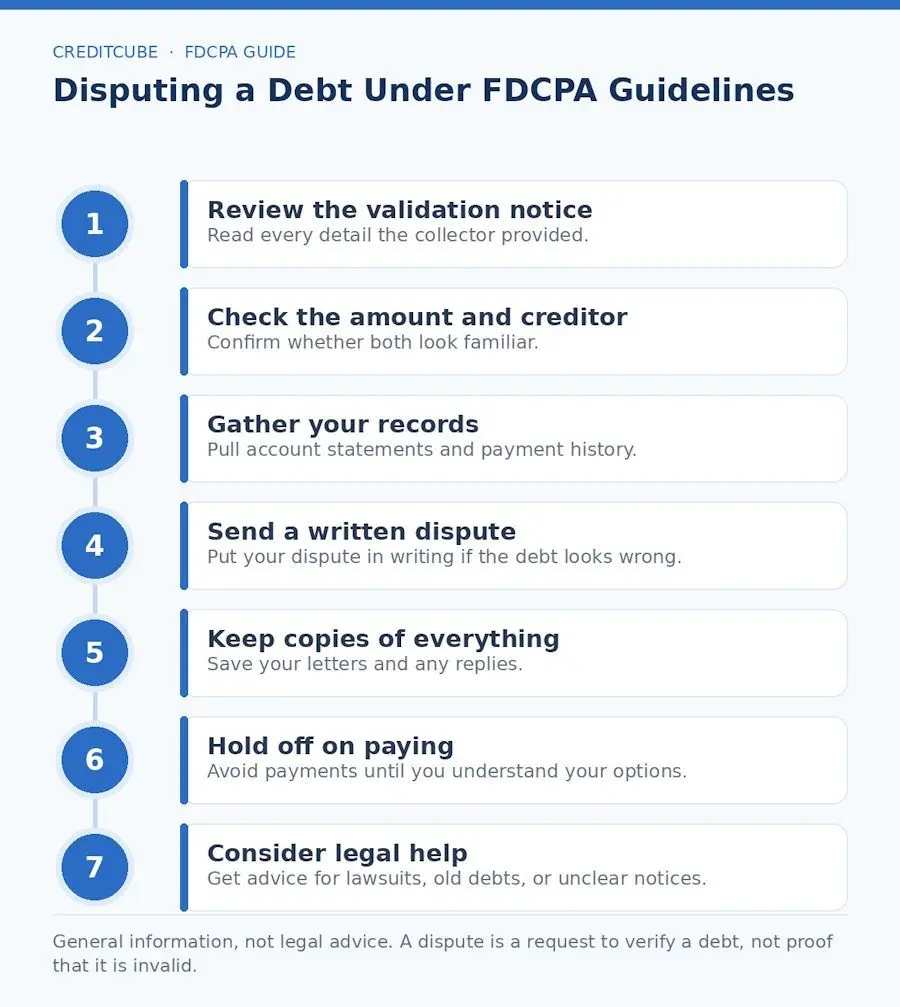
To dispute a debt, you review the validation notice, confirm the details, gather your records, and send a written dispute, keeping copies of everything. A dispute does not automatically make a debt invalid. It is a way to ask the collector to review and verify it.
- Review the validation notice. Read every detail the collector provided.
- Check the amount and creditor. Confirm whether both look familiar.
- Gather your records. Pull account statements and payment history.
- Send a written dispute. Put your dispute in writing if the debt looks wrong.
- Keep copies of everything. Save your letters and any replies.
- Hold off on paying. Verify the debt promptly before deciding whether to pay. A dispute does not itself cancel the debt or automatically suspend payment obligations, interest, fees, or court deadlines. Seek legal advice promptly if you receive court papers.
- Consider legal help. Get advice for lawsuits, very old debts, or unclear notices.
This guide provides general information rather than legal advice. Because a written dispute has specific timing and legal effects, consider reviewing your options with a qualified attorney. One detail on that list, a debt's age, deserves its own look.
Time-Barred Debt and Why It Matters?
Time-barred debt is debt that may be too old for a collector to sue over, based on your state's statute of limitations. The rules vary by state and by the type of debt, so the same debt can be treated differently depending on where you live.
Age matters because making a payment or a written promise can sometimes restart the clock. That does not mean you should ignore the debt. It means you should be cautious, check your state's rules, and consider speaking with a qualified attorney first.
This section contains general information, not legal advice. Since statute-of-limitations rules depend on state law, confirm your local regulations before taking action.
With timing covered, it helps to see how the FDCPA sits next to related laws.
FDCPA vs. FCRA vs. State Debt Collection Laws
The FDCPA, the FCRA, and state laws cover different parts of debt and credit: the FDCPA governs collector conduct, the FCRA governs credit reporting, and state laws add their own protections.
The table below sums up each one.
| Law / Rule | What it generally covers |
|---|---|
| FDCPA | The conduct of covered debt collectors when collecting consumer debts |
| Regulation F | Detailed federal debt collection rules that implement the FDCPA |
| FCRA | Credit reporting and disputes tied to your credit reports |
| State debt collection laws | Added state-level protections, which vary by state |
These laws often work together on the same debt. For a look at another federal compliance area lenders deal with, see guide on BSA AML compliance. Now let’s dig into what to do when a collector reaches out.
What to Do If a Debt Collector Contacts You
If a debt collector contacts you, stay calm, confirm who they are, review the validation notice, and keep written records of every contact. A measured response protects you better than panic or silence.
- Stay calm. Do not share unnecessary personal information.
- Identify the collector. Ask for the name, company, and contact details.
- Review the validation notice. Request it or read the one you received.
- Compare it with your records. Match the claim against what you have.
- Keep written records. Log every call and message.
- Dispute in writing. To trigger the validation-related collection pause, submit your dispute in writing within the validation period, generally 30 days after receiving the validation information. An accepted electronic channel, such as the collector’s designated email address or portal, can satisfy the writing requirement. The collector generally must stop collecting the disputed amount until it sends verification or a copy of a judgment. You may still dispute afterward, but that automatic pause generally does not apply.
- Watch for violations. Note any harassment, threats, or misleading claims.
- File a complaint if needed. You can report a collector to the CFPB or the FTC.
- Get legal help for lawsuits. Speak with a qualified attorney if you receive a court notice.
This checklist offers general guidance rather than legal advice. If you face a lawsuit or court deadline, speak with a qualified attorney promptly.
CreditCube's Approach to Responsible Communication
At CreditCube, clear financial communication is part of responsible lending. Before you sign, you should understand your loan agreement, your payment schedule, and your account obligations. Knowing these upfront helps you avoid surprises later.
If you have questions about an account, your repayment terms, or your communication preferences, review your agreement and reach the right support channel. It also helps to understand the documents you approve when you E-sign loan paperwork. A clear agreement from the start supports a smoother repayment experience.
This section provides general information on communication practices and is not a legal claim or statement about a specific account. Your loan agreement sets out your account terms, subject to applicable law. It does not override applicable consumer-protection rights.
Even with clear communication, it helps to recognize the warning signs of a bad actor.
Common FDCPA Red Flags to Watch Out
Common FDCPA red flags include threats of arrest, repeated abusive calls, contact at banned hours, and public posts about your debt. These are signs a collector may be crossing a legal line.
- Threats of arrest. Claims you will be jailed over an ordinary consumer debt.
- Repeated abusive calls. A pattern of harassing or back-to-back contact.
- Contact at banned times. Calls before 8 a.m. or after 9 p.m.
- Public debt posts. Social media posts that expose your debt.
- False legal claims. Fake lawsuits or made-up legal authority.
- Refusing debt details. Declining to give basic information about the debt.
- Interference with dispute rights. Continuing to collect a disputed amount, or demanding payment, when a timely written dispute should pause collection until the collector verifies the debt.
- Disclosing to others. Revealing your debt to friends, family, or your employer.
Keep one thing in mind: not every unwanted contact is automatically illegal. The details decide. Beyond handling collectors, a few habits keep debt manageable in the first place.
Responsible Borrowing and Debt Management Tips
Responsible borrowing comes down to understanding a loan before you take it and acting early if payments get hard. These habits help you stay ahead of debt rather than behind it.
- Read loan terms first. Know the details before you sign. Our guide on how to get approved for a loan explains what to expect.
- Understand total repayment. Know the full amount you will repay, not just the monthly figure.
- Keep copies of agreements. Save every document for your records.
- Reach out early. Contact the lender as soon as payment trouble appears.
- Avoid debt stacking. Before taking something like quick personal loans to cover an old debt, review the cost.
- Seek support for hardship. Consider budgeting help or nonprofit credit counseling.
Good habits like these reduce the odds of a collector ever calling. Here are the questions readers ask most.
FAQs About the Truth in Lending Act
What are FDCPA guidelines?
FDCPA guidelines are federal rules that limit how covered debt collectors can collect certain consumer debts. They prohibit abusive, unfair, and deceptive practices.
What does the Fair Debt Collection Practices Act cover?
It generally covers the collection of consumer debts for personal, family, or household purposes by covered debt collectors.
Does the FDCPA apply to original creditors?
It generally applies to third-party debt collectors, not always to the original creditor. Even so, state laws or other consumer-protection laws may still apply.
What are examples of unfair debt collection practices?
Examples may include harassment, false statements, threats that are not legally valid, improper disclosure of your debt to others, or contact at prohibited times or places.
Can a debt collector contact me by text or email?
Yes, collectors may use some electronic messages, but rules apply. Each electronic collection communication or attempt must include a clear, reasonable, and simple way to opt out of further messages to that electronic address or number. Private social-media messages remain subject to identification, privacy, contact restrictions, and requests to stop using that channel.
What should I do if I do not recognize a debt?
Review the validation notice, compare it with your records, and consider disputing the debt in writing. Keep copies of all communication.
Can I file a complaint about a debt collector?
Yes. You can submit a complaint to regulators such as the CFPB or FTC if you believe a collector used abusive, unfair, or deceptive practices.
Recent Articles
Emergency Car Repair Loans: Fast Help for Urgent Repairs
Emergency car repair loans explained. Learn costs, approval factors, risks, ...E-sign Loan Documents: How E-Signatures Work
Learn how to e-sign loan documents online, what e-consent means, and what to...Quick Loans in 2026: How to Apply and Get Approved Fast
Quick loans guide for 2026. Learn how to apply, approval steps, requirements...Fair Lending: How to Spot Deceptive Loan Ads
Fair lending protects borrowers with clear, honest loan terms. Learn to spot...Otter Lending Alternatives for Fast Loans
Need a quick loan? Check out the best Otter Lending alternatives like Rise C...Emergency Dental Loans: Compare Your Funding Options
Emergency dental loans may help cover urgent care. Compare dental funding op...Get your money today
Apply for a loan NOW!
Applying does NOT affect your FICO® Score!
Have questions?
Please call us by phone:
Credit Cube © 2026. All rights reserved
CreditCube is a Tribal enterprise, wholly owned and operated by the Big Valley Band of Pomo Indians, a federally-recognized American Indian tribe and sovereign government. Any Agreement entered into as a result of this Application shall be governed by applicable Tribal and federal law. Each aspect of communication and transaction with/on this site will be deemed to have occurred in CreditCube’s Big Valley Band of Pomo Indian Reservation offices, regardless of the location where you are accessing or viewing this site.
⚠ Please note: This is an expensive form of borrowing. CreditCube loans are designed to assist you in meeting your short-term borrowing needs and are not intended to be a long-term financial solution! Examples of emergency reasons why these loans might be used include unexpected emergencies, car repair bills, medical care, or essential travel expenses.
* Loan approvals are subject to underwriting. Approval may take longer if additional verification documents are requested. Not all loan requests are approved. CreditCube reviews your information in real-time to determine whether your information meets our lending criteria. You acknowledge that by completing and submitting the website application that you are applying for a Loan. We verify applicant information through national databases including, but not limited to, Clarity Services, Inc., a credit reporting agency, and we may pull your credit in order to determine your eligibility and ability to repay.
** Maximum loan amount is $500 for first-time customers. For returning CreditCube customers, rates may go down over time based on your CreditCube Loyalty Program status and your payment history with us. Please see our Loyalty Program page for more information.
*** Loan Applications processed and approved before 3pm EST Monday-Friday are typically funded on the next business day. Example: If your loan is processed and approved on Friday before 3pm EST, the loan will typically be funded on the following Monday. Deposit times may vary depending on your bank. Business Day means Monday through Friday excluding all federal banking holidays.
CreditCube does not lend to residents of Pennsylvania, Connecticut, Minnesota, New York, Vermont, Virginia, West Virginia, Illinois, Georgia and North Carolina. Availability of installment loans in your state is subject to change at any time with or without notice at the sole discretion of CreditCube.