BSA AML Compliance: The Role of the BSA/AML Policy in Keeping Transactions Safe

Safety in lending is not only about secure websites or fast forms. Loan transactions involve sensitive personal, financial, and banking information. That is why responsible lenders need policies and controls that help protect customers.
So what role does a BSA/AML policy play in keeping transactions safe? It gives a lender one clear plan. That plan sets out how to review customer information, watch for unusual activity, and report suspicious behavior. This structure helps reduce financial crime risks.
BSA AML compliance is one part of that safety framework. It shapes how a lender reviews information, watches for suspicious activity, and keeps clear records. Whether someone applies for personal loans or other products, these controls work in the background. CreditCube is a tribal installment loan provider and is not licensed by the Florida Office of Financial Regulation. In this article, we explain what BSA AML compliance means, how it applies to loans, and what borrowers can expect. This type of borrowing is expensive, with APRs ranging between 200% and 700%. Tribal installment loans are not intended as a long‑term financial solution.
This page is for general educational purposes only and is not legal, regulatory, or compliance advice. It does not describe CreditCube’s specific policies or procedures.
Understanding the Bank Secrecy Act (BSA) and AML Requirements
BSA stands for the Bank Secrecy Act. AML stands for anti money laundering. Together, they describe a set of rules that financial institutions follow to fight financial crime. Not all lenders are treated as “financial institutions” under every BSA/AML rule; obligations depend on the entity’s structure and activities.
BSA AML compliance is the framework financial institutions use to help detect, prevent, and report activity that may involve money laundering, terrorist financing, or other suspicious financial behavior. It supports recordkeeping, monitoring, and risk management across the financial system.
The Bank Secrecy Act works alongside agencies like FinCEN, the Financial Crimes Enforcement Network. These rules guide how institutions handle currency, review customers, and report concerns. With the basics defined, it helps to see why this matters specifically in lending.
Why Does Anti Money Laundering Matter in Lending?
Lending can involve identity data, income data, bank accounts, and payment movement. Bad actors can misuse each of these. That is where anti money laundering controls come in. These controls lower the risk of using loans to move funds or hide ownership. They also flag transactions that have no clear purpose. A lender may review customer information and transaction patterns to spot activity that does not add up.
These reviews usually include identity review, customer due diligence, transaction monitoring, and suspicious activity review. They form part of responsible lending operations. Applying for installment loans means some of these checks happen in the background. The next section explains the policy that ties them together.
Why Are BSA/AML Policies Vital for Transaction Security?
A BSA/AML policy gives a lender a clear plan. It defines who does what and how the whole process runs. Without a written policy, teams would make ad hoc decisions that are hard to review. Federal regulators outline these expectations in the FFIEC BSA/AML Examination Manual, the interagency reference used to examine institutions for compliance.
A strong policy defines who is responsible for compliance, what customer information is reviewed, and how suspicious activity is monitored. It also sets out how internal teams are trained, how records are maintained, how issues are escalated, and how the policy itself is reviewed and updated.
| BSA/AML policy area | How it supports safer transactions |
|---|---|
| Internal controls | Creates consistent review processes |
| Customer due diligence | Helps understand customer identity and transaction purpose |
| Monitoring | Helps identify unusual or unexpected activity |
| Training | Helps staff recognize potential red flags |
| Independent testing | Reviews whether controls are working |
| Recordkeeping | Supports auditability and accountability |
Each area plays a role in a larger compliance program. The next section breaks down those parts one by one.
What Are the Key Parts of a BSA/AML Compliance Program?
An AML compliance program is built from several pillars. Each one supports the others. Together, they help a financial institution meet its obligations.
- Written Policies and Internal Controls. Policies help teams follow consistent procedures instead of making ad hoc decisions. They set clear steps for review, so outcomes stay predictable and fair.
- Compliance Officer Oversight. A designated compliance officer or team coordinates and monitors AML responsibilities. This person makes sure the program runs as designed and stays current.
- Ongoing Training. Staff training helps teams identify suspicious behavior and understand escalation paths. It also helps them apply procedures the same way each time.
- Independent Testing. Independent testing checks whether the AML program is working as intended. A fresh set of eyes can spot gaps that daily staff might miss.
- Customer Due Diligence. Customer Due Diligence helps financial institutions understand customer relationships. It also helps them identify activity that does not match expected patterns. These pillars matter most when applied to real loan transactions.
How Does BSA AML Compliance Apply to Loan Transactions?
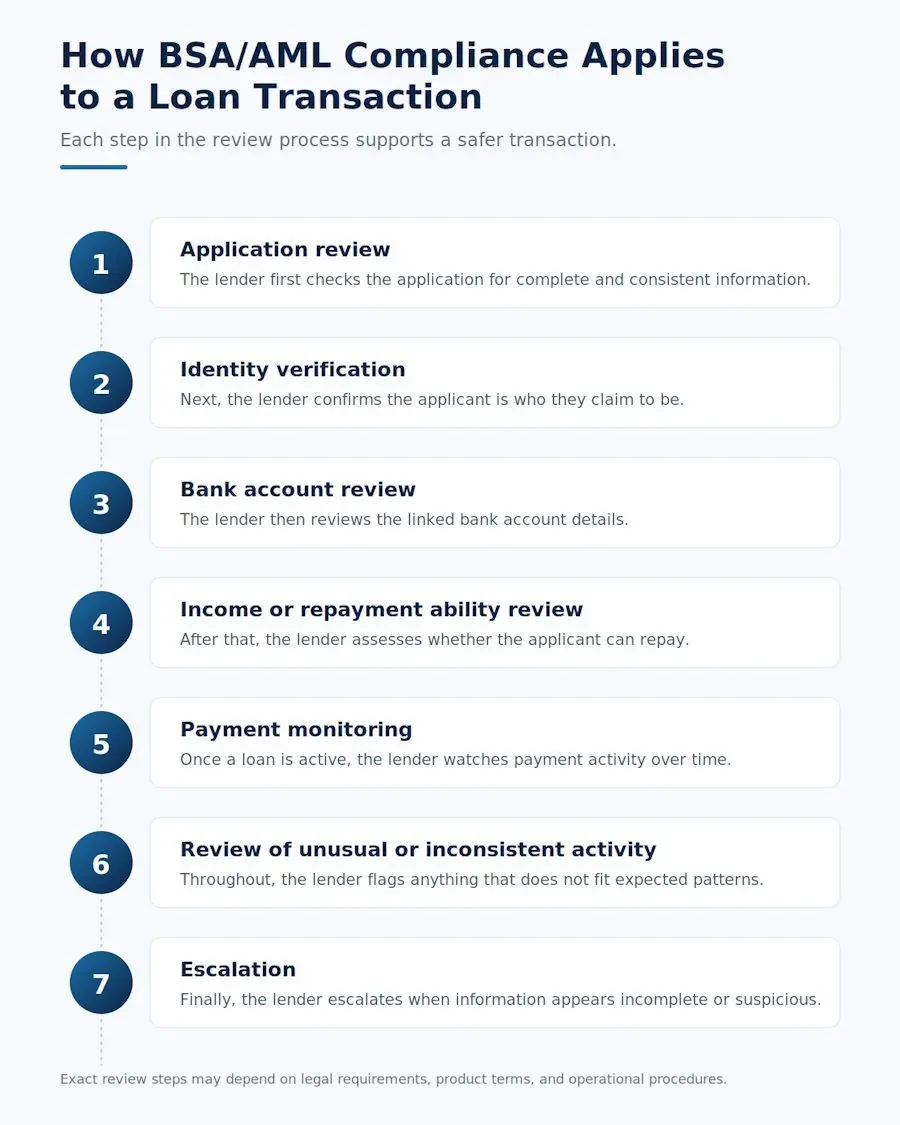
Generic banking rules become concrete during a loan. Here is where the controls actually show up. Each step supports a safer transaction.
- Application review. The lender first checks the application for complete and consistent information.
- Identity verification. Next, the lender confirms the applicant is who they claim to be.
- Bank account review. The lender then reviews the linked bank account details.
- Income or repayment ability review. After that, the lender assesses whether the applicant can repay.
- Payment monitoring. Once a loan is active, the lender watches payment activity over time.
- Review of unusual or inconsistent activity. Throughout, the lender flags anything that does not fit expected patterns.
- Escalation. Finally, the lender escalates when information appears incomplete, mismatched, or suspicious.
At CreditCube, loan-related reviews may include customer information, eligibility details, banking information, and other factors relevant to the application and repayment process. Exact review steps may depend on legal requirements, product terms, and operational procedures. Part of that review involves watching for warning signs, which the next section covers.
What Are Common Anti Money Laundering Red Flags in Lending?
Certain patterns raise questions during a review. None of these prove wrongdoing on their own. Instead, they signal that a closer look may be needed.
- Inconsistent identity information
- Unclear source of funds
- Activity that does not match the stated loan purpose
- Third-party involvement without a clear explanation
- Rapid or unusual payment movement
- Loan activity with no clear business or personal purpose
- Attempts to avoid verification steps
These red flags help staff decide when to escalate. Understanding them also clarifies how BSA AML compliance differs from related terms.
BSA AML Compliance vs. AML Banking Compliance: What Is the Difference?
The two phrases sound alike, and they overlap. Still, they are not identical. The difference comes down to scope.
AML banking compliance usually refers to AML requirements and controls used by banks and regulated banking institutions. BSA AML compliance is often used more broadly in the U.S. context. It describes compliance with the Bank Secrecy Act and related anti money laundering requirements.
Loan and finance companies may have different obligations. These depend on their structure, products, partners, and applicable rules.
This article is for general education only and should not be treated as legal, regulatory, or compliance advice.
With the terms clarified, it helps to see how these rules protect people.
How Do Anti Money Laundering Regulations Protect You and Financial Systems?
These rules do more than satisfy regulators. They also help everyday borrowers and the wider financial system. The benefits reach in several directions.
Anti money laundering regulations help:
- Reduce misuse of financial products
- Support safer handling of sensitive financial information
- Encourage consistent customer review
- Create accountability through recordkeeping and monitoring
- Detect suspicious activity
- Maintain trust in financial services
These protections work best when borrowers understand what to expect during an application.
What Might You Notice During a Loan Application?
The compliance process is not invisible to applicants. Some steps ask for information directly. Knowing why helps the process feel less like a hurdle.
Borrowers may be asked to provide:
- Legal name
- Contact information
- Identity details
- Income information
- Bank account information
- State of residence
- Additional verification details if needed
These requests serve clear goals. They confirm identity, assess eligibility, and support responsible review. They also help keep transactions safer and meet applicable compliance obligations. Some applicants may also complete steps like E Sign Loan Documents as part of the process.
Verification can feel like friction, but it serves a purpose worth understanding.
Understanding the Importance of Verification
Extra steps can feel slow in the moment. Yet they protect both sides of the transaction. A short pause now can prevent bigger problems later.
Verification helps in several ways:
- It protects the borrower and the lender.
- It helps reduce identity misuse.
- It helps confirm that information is accurate.
- It supports responsible lending review.
- It helps keep loan transactions more transparent.
CreditCube aims to keep the online loan process clear and responsible. Verification steps help support that goal, even when they require additional information from the applicant. This responsible approach shapes how CreditCube handles transactions overall.
What Is CreditCube's Approach to Safe and Responsible Loan Transactions?
CreditCube offers tribal installment loans. Every loan application involves review before approval. Approval is not guaranteed. Also, this type of borrowing is expensive one. APRs vary between 200% and 700%.
Terms, availability, costs, funding timing, and eligibility depend on several factors. These include the applicant's situation, state availability, and the final agreement. Responsible borrowing and repayment planning matter at every step.
CreditCube is a tribal installment lender. As part of a responsible lending process, CreditCube may review applicant information, eligibility details, and repayment-related factors before a loan decision is made. Borrowers should always read the loan agreement carefully. They should also confirm that repayment fits their budget before signing.
For teams building lending content, a checklist helps keep these principles in view.
What Should Your BSA AML Compliance Checklist Include?
Use this checklist as a quick reference. It captures the core parts of a sound program. Each item supports safer transactions.
- Clear customer identification process
- Written AML policies
- Internal controls
- Compliance officer oversight
- Staff training
- Independent testing
- Customer due diligence
- Transaction monitoring
- Suspicious activity escalation
- Recordkeeping
- Periodic review and updates
A checklist shows what compliance includes. It also helps to clear up what it does not.
What Shouldn't You Expect From BSA AML Compliance?
Compliance is powerful, but it has limits. Some claims stretch it too far. Here is what it does not promise.
BSA AML compliance does not mean:
- Every transaction is guaranteed to be fraud-free
- Every applicant will be approved
- A loan has no risk
- A lender can skip state or federal expectations
- Verification is optional
- Borrowers should ignore repayment responsibilities
Final Takeaway
BSA AML compliance helps lenders create consistent policies and review customer information. It also helps them monitor suspicious activity and support safer loan transactions.
In lending, anti money laundering controls are not only regulatory requirements. They are part of a responsible process that helps protect borrowers, lenders, and the financial system.
FAQs - BSA AML Compliance
What is BSA AML compliance?
BSA AML compliance is a set of policies, controls, and reporting practices. They help financial institutions reduce money laundering risk. They also address terrorist financing risk.
How does anti money laundering apply to loans?
It applies in several ways. Lenders use identity review and customer due diligence. They also use transaction monitoring, suspicious activity review, recordkeeping, and internal controls.
What are anti money laundering loans?
The phrase refers to loan products or processes that include AML checks. It does not describe a special type of loan.
Why do lenders ask for identity and banking information?
Lenders use it to verify identity. It also helps them review eligibility. And it helps them assess repayment ability and meet compliance obligations.
Is BSA AML compliance the same as AML banking compliance?
They are closely related. AML banking compliance covers controls in banking. BSA AML compliance is broader. It covers U.S. Bank Secrecy Act and AML duties.
Does BSA AML compliance guarantee transaction safety?
No. It helps reduce and monitor risk. But it does not promise that every transaction is risk-free. Fraud can still occur.
Does CreditCube use BSA/AML controls?
CreditCube may use review and verification steps. These are part of responsible lending. Exact procedures depend on applicable rules, product terms, and policies.
Recent Articles
Emergency Loan for Bad Credit: Fast Options & Key Tips
Emergency loan for bad credit options explained: types, requirements, pros, ...Hardship Loans for Bad Credit: Options, Rates, and Risks
Hardship loans for bad credit explained. Learn how they work, who qualifies,...Cash Advance vs Installment Loan: Key Differences Explained
Cash advance vs installment loan: compare costs, repayment, and funding cons...Medical Loans for Bad Credit: Fast Help for Bills
Medical loans for bad credit explained. Learn how they work, who qualifies, ...TCPA Loan Calls: Know Your Rights & Spot Scams
TCPA loan calls can mean marketing, servicing, or scams. Learn your rights, ...Bank Statement Loan Review: What Lenders Check
A bank statement loan review helps lenders assess income and underwriting fa...Get your money today
Apply for a loan NOW!
Applying does NOT affect your FICO® Score!
Have questions?
Please call us by phone:
Credit Cube © 2026. All rights reserved
CreditCube is a Tribal enterprise, wholly owned and operated by the Big Valley Band of Pomo Indians, a federally-recognized American Indian tribe and sovereign government. Any Agreement entered into as a result of this Application shall be governed by applicable Tribal and federal law. Each aspect of communication and transaction with/on this site will be deemed to have occurred in CreditCube’s Big Valley Band of Pomo Indian Reservation offices, regardless of the location where you are accessing or viewing this site.
⚠ Please note: This is an expensive form of borrowing. CreditCube loans are designed to assist you in meeting your short-term borrowing needs and are not intended to be a long-term financial solution! Examples of emergency reasons why these loans might be used include unexpected emergencies, car repair bills, medical care, or essential travel expenses.
* Loan approvals are subject to underwriting. Approval may take longer if additional verification documents are requested. Not all loan requests are approved. CreditCube reviews your information in real-time to determine whether your information meets our lending criteria. You acknowledge that by completing and submitting the website application that you are applying for a Loan. We verify applicant information through national databases including, but not limited to, Clarity Services, Inc., a credit reporting agency, and we may pull your credit in order to determine your eligibility and ability to repay.
** Maximum loan amount is $500 for first-time customers. For returning CreditCube customers, rates may go down over time based on your CreditCube Loyalty Program status and your payment history with us. Please see our Loyalty Program page for more information.
*** Loan Applications processed and approved before 3pm EST Monday-Friday are typically funded on the next business day. Example: If your loan is processed and approved on Friday before 3pm EST, the loan will typically be funded on the following Monday. Deposit times may vary depending on your bank. Business Day means Monday through Friday excluding all federal banking holidays.
CreditCube does not lend to residents of Pennsylvania, Connecticut, Minnesota, New York, Vermont, Virginia, West Virginia, Illinois, Georgia and North Carolina. Availability of installment loans in your state is subject to change at any time with or without notice at the sole discretion of CreditCube.