Fair Lending: Recognizing and Avoiding Deceptive Loan Marketing

Fair lending generally refers to providing credit without unlawful discrimination. It includes treating applicants and borrowers consistently and not discriminating on a prohibited basis in application, underwriting, pricing, servicing, or other aspects of a credit transaction. Separate consumer-protection and advertising rules also require loan information and marketing to be truthful, accurate, and not misleading.
Deceptive loan ads may use claims like guaranteed approval, no credit check, instant cash, or hidden-fee language. Safe borrowing starts with comparing the total cost, reading the agreement, and avoiding pressure before signing.
If you are researching options like short term personal loans, understanding these signals matters even more. CreditCube supports clear loan education so borrowers can review the facts on their own terms.
Fair lending covers more than approval decisions. It also means no discriminatory treatment, clear and accurate loan information, responsible lending communication, truthful advertising, and fair access to credit based on lawful eligibility factors. And it relates to how loan offers, eligibility, and terms are presented, not only to who gets approved.
The Hidden Dangers of Misleading Loan Ads
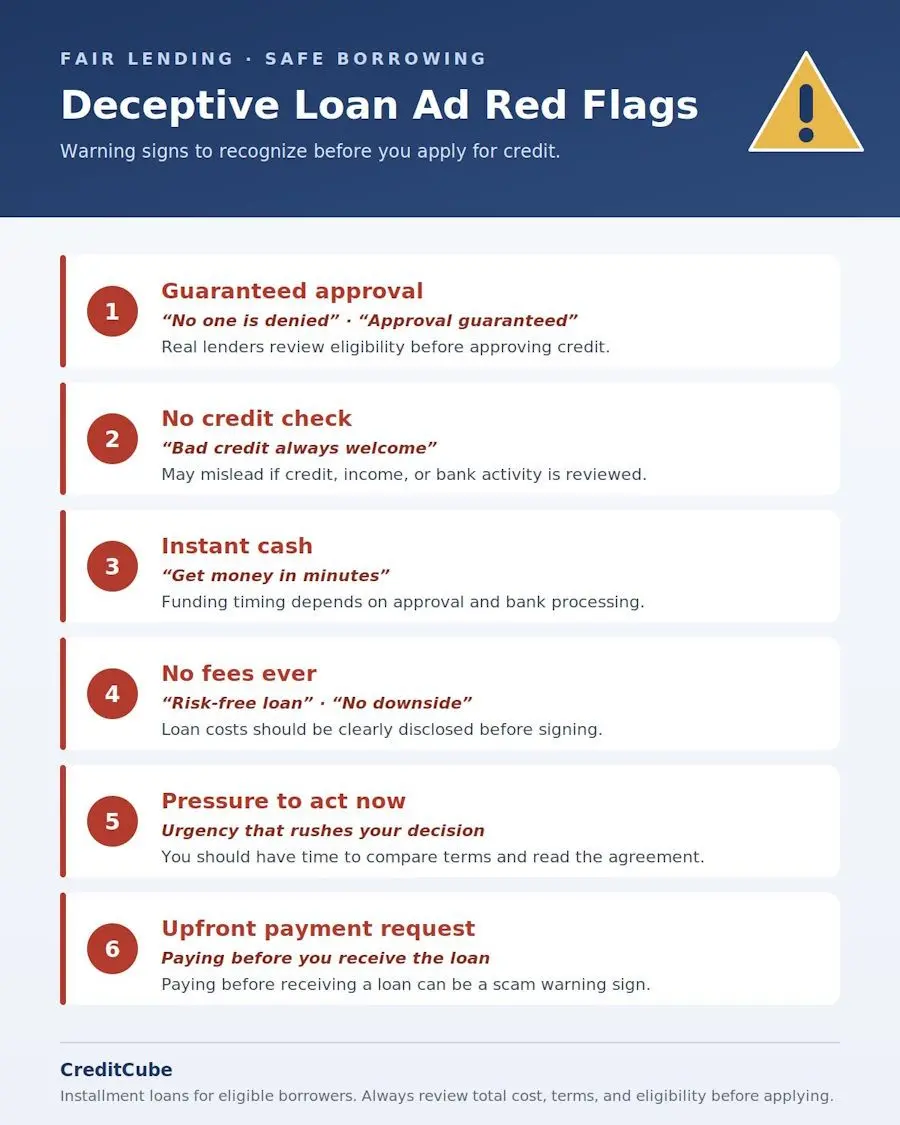
Deceptive loan ads can set misleading expectations. They may hide costs, push borrowers to apply quickly, or leave repayment obligations unclear. Some make claims that sound guaranteed. Others use language that minimizes risk.
Watch for phrases like these:
- "Guaranteed approval"
- "No one is denied"
- "Instant cash"
- "No fees ever"
- "No credit check"
- "Risk-free loan"
- "Bad credit always welcome"
Claims like these can lead consumers to apply without understanding the costs, their repayment responsibilities, or the eligibility rules that apply.
Red Flags: How to Spot a Deceptive Loan Ad
| Warning sign | Why it matters |
|---|---|
| Guaranteed approval | Real lenders usually need to review eligibility before approving credit |
| No credit check | This may mislead if the lender reviews credit, income, bank activity, or repayment ability |
| Instant cash | Funding timing may depend on approval, bank processing, and agreement completion |
| No fees ever | Loan costs should be clearly disclosed before signing |
| Pressure to act now | Borrowers should have time to compare terms and read the agreement |
| Upfront payment request | Paying before receiving a loan can be a scam warning sign |
| Vague repayment terms | Borrowers need to know payment dates, costs, and consequences |
| Missing lender information | Legitimate lenders should be identifiable and transparent |
Please note that an upfront payment request can be a serious warning sign, especially when a company asks you to pay for a guaranteed loan, approval, or release of funds. Do not assume that every application-related fee is unlawful; review the fee, its purpose, when it is charged, and the applicable disclosures.
Fair Lending: The Importance of Transparent Marketing
Loan ads should not mislead by what they say or what they leave out. Material loan terms should not be hidden. Borrowers should understand the type of loan being offered. An ad should not imply availability for every applicant or every state. And it should not present borrowing as a guaranteed fix.
A loan ad can be short and still be accurate. If important details are missing, the borrower should review the full terms before applying or signing. For background on fair lending protections, borrowers can review the Consumer Financial Protection Bureau's fair lending resources.
Decoding Loan Ads: Deceptive Claims vs. Honest Terms
| Deceptive wording | Safer wording |
|---|---|
| Get guaranteed approval today | Apply and receive a decision if eligible |
| No credit check loan | Eligibility may include review of income, credit history, banking activity, and other factors |
| Instant cash in minutes | Funding timing depends on approval, agreement completion, bank processing, and other factors |
| No fees ever | Review all costs, fees, and repayment terms before signing |
| Best rates available | Compare the full cost of borrowing and review your agreement |
| Everyone qualifies | Eligibility requirements apply |
| No downside | Borrowing has costs and repayment obligations |
| Fix your finances today | A loan may be one option for a temporary need, but it is not a guaranteed solution |
The Principles of Safe Borrowing
Safe borrowing means understanding the total cost, knowing when payments are due, and checking whether the payment fits your budget. It also means comparing alternatives, avoiding pressure, reading the agreement, confirming the lender's identity, and knowing what happens if a payment is missed.
Safe borrowing starts before an application is submitted. A borrower should understand why they need the loan, how much they need, how the loan will be repaid, and whether repayment will affect essential expenses such as rent, food, transportation, or utilities.
Key Questions Before You Apply
Before responding to loan ads, ask:
- Is the lender clearly identified?
- Does the ad explain what type of loan this is?
- Are approval and funding claims conditional?
- Are costs, fees, and repayment terms clearly available?
- Does the ad pressure me to act quickly?
- Does the ad promise approval before reviewing my information?
- Does the lender ask for money before providing the loan?
- Can I review the agreement before signing?
- Can I afford the repayment schedule?
- Have I compared alternatives?
Fair Lending: Understanding CreditCube's Approach
CreditCube offers tribal installment loans for eligible borrowers. It is an installment loan option, not a grant, payday advance, government benefit, or guaranteed solution. Installment loans are an expensive form of borrowing, so before applying, borrowers should review eligibility requirements, state availability, total cost, repayment terms, and the final loan agreement. Borrowers who are comparing credit paths, including installment loans for bad credit, should confirm the specific terms that apply to them.
How to Compare Loan Offers Safely
When comparing offers, look at the APR, fees, total repayment amount, payment schedule, due dates, and late-payment consequences. Also check the lender's identity, state availability, eligibility requirements, and whether the payment fits your budget.
| What to compare | Why it matters |
|---|---|
| APR | Helps estimate the annualized cost of credit |
| Fees | Extra costs can affect total repayment |
| Total repayment amount | Shows what the borrower may pay overall |
| Payment schedule | Helps determine whether payments fit the budget |
| Eligibility rules | Prevents misunderstanding about who may qualify |
| State availability | Loan availability can vary by location |
| Missed-payment consequences | Helps borrowers understand repayment risk |
| Alternatives | Borrowing may not be the best first option |
Alternatives to Consider Before Borrowing
A loan is one option, but it is not always the first or best one. Depending on your situation, another path may cost less or carry fewer obligations. Consider these before you apply.
- Payment plan with a service provider. Many utility companies, medical offices, and other providers let you split a bill into smaller payments over time. This may cost little or nothing, and it can cover a shortfall without a new loan. Ask the provider directly, since plans are often available even when they are not advertised.
- Emergency savings. Using money you have already set aside avoids interest and repayment obligations entirely. Even a partial payment from savings can shrink the amount you need to cover another way. If you do not have savings yet, this is a reminder of why a small fund helps for next time.
- Budget adjustment. Reviewing your spending may free up money you did not expect. Cutting, pausing, or delaying some expenses for a short period can cover a gap without borrowing. Start with non-essential costs so that rent, food, and utilities stay protected.
- Employer paycheck advance. Some employers offer an advance on wages you have already earned, often at little or no cost. This can bridge a short gap before your next payday. Check with your HR or payroll contact to see whether this option exists where you work.
- Credit union small-dollar loan. Some credit unions offer small loans designed as a lower-cost alternative to high-cost credit. Terms vary by institution, so compare the total cost and repayment schedule before committing. You usually need to be a member, though joining is often straightforward.
- Nonprofit credit counseling. A counselor can review your budget, explain your options, and help you build a repayment plan. Many nonprofit services are low-cost or free. This can be useful if you are weighing several bills or debts at once and want a clearer picture before deciding.
- Help from family or community resources. Local assistance programs, community organizations, or people you trust may offer short-term help. Support like this can reduce or remove the need to borrow. Community resources sometimes assist with specific costs such as food, rent, or utilities.
- Delaying non-essential expenses. Postponing a purchase that can wait may remove the need to borrow right now. Ask whether the expense is urgent or whether it can hold until your finances are steadier. A short delay can be enough to avoid taking on new costs.
What to Do If a Loan Ad Seems Misleading
- Do not click suspicious links.
- Do not provide bank information through an unexpected text, email, or call.
- Do not pay an upfront fee to receive a loan.
- Take screenshots of the ad.
- Research the lender.
- Review official consumer-protection resources.
- Report suspicious activity to the appropriate consumer-protection agency.
- Consider speaking with a trusted financial counselor or legal aid resource.
Fair Lending Checklist for Borrowers
A borrower is closer to safe borrowing when:
- The loan type is clear.
- The lender is identifiable.
- Approval is not described as guaranteed.
- Costs are available before signing.
- Repayment terms are understandable.
- The agreement can be reviewed before signing.
- The borrower understands what happens if payment is missed.
- The borrower has compared alternatives.
- The borrower is not being pressured.
- The borrower can afford repayment.
Conclusion
Fair lending helps protect borrowers. Deceptive loan ads can mislead consumers about approval, cost, and repayment. Safe borrowing requires comparing total cost, terms, and alternatives before signing. CreditCube is an installment loan option for eligible borrowers, not a guaranteed or risk-free solution.
FAQ About Fair Lending, Deceptive Loan Ads, and Safe Borrowing
What is fair lending?
Fair lending means borrowers should be treated fairly and receive accurate information when seeking credit. It includes lawful eligibility review, nondiscriminatory treatment, and clear communication about loan terms, costs, and repayment obligations.
What are deceptive loan ads?
Deceptive loan ads are ads that may mislead borrowers about approval, costs, eligibility, funding timing, or repayment. Examples may include claims like guaranteed approval, instant cash, no fees, or no credit check when those claims are not accurate or fully explained.
Why are guaranteed approval loan ads risky?
Guaranteed approval language can be risky because legitimate lenders usually need to review eligibility before approving a loan. Borrowers should be cautious when an ad promises approval before reviewing income, credit history, repayment ability, or other lawful factors.
What does safe borrowing mean?
Safe borrowing means understanding the full cost, repayment schedule, fees, eligibility rules, and consequences before signing a loan agreement. It also means comparing alternatives and avoiding pressure-based decisions.
How can I check if loan ads are trustworthy?
Check whether the lender is clearly identified, whether the terms are transparent, whether approval claims are conditional, and whether the loan agreement explains costs and repayment. Be especially cautious when an advertiser requests money before providing a loan or promises that payment will guarantee approval or release of funds. Verify the lender independently and review the fee disclosures and loan terms before providing payment or personal information.
Is CreditCube a payday loan?
CreditCube offers tribal installment loans for eligible borrowers. Repayment terms, costs, approval, availability, and funding timing depend on eligibility, state availability, bank processing, and the final loan agreement.
Recent Articles
Emergency Loan for Bad Credit: Fast Options & Key Tips
Emergency loan for bad credit options explained: types, requirements, pros, ...Personal Holiday Loans: What Borrowers Should Know
Personal holiday loans explained. Learn how they work, eligibility requireme...Cash Advance App Fees: What They Really Cost
Cash advance app fees can hide more than one charge. Learn the full cost, re...Electronic Funds Transfer Act: EFTA Rules for Borrowers
EFTA regulations set rules for automatic loan payments and electronic transf...Loans Tallahassee: How Long Funding Takes
Compare loans Tallahassee options and funding timelines. Learn what affects ...Installment Loans Plano TX: Funding Timelines
Installment loans, personal loans, payday loans in Plano TX: see what shapes...Get your money today
Apply for a loan NOW!
Applying does NOT affect your FICO® Score!
Have questions?
Please call us by phone:
Credit Cube © 2026. All rights reserved
CreditCube is a Tribal enterprise, wholly owned and operated by the Big Valley Band of Pomo Indians, a federally-recognized American Indian tribe and sovereign government. Any Agreement entered into as a result of this Application shall be governed by applicable Tribal and federal law. Each aspect of communication and transaction with/on this site will be deemed to have occurred in CreditCube’s Big Valley Band of Pomo Indian Reservation offices, regardless of the location where you are accessing or viewing this site.
⚠ Please note: This is an expensive form of borrowing. CreditCube loans are designed to assist you in meeting your short-term borrowing needs and are not intended to be a long-term financial solution! Examples of emergency reasons why these loans might be used include unexpected emergencies, car repair bills, medical care, or essential travel expenses.
* Loan approvals are subject to underwriting. Approval may take longer if additional verification documents are requested. Not all loan requests are approved. CreditCube reviews your information in real-time to determine whether your information meets our lending criteria. You acknowledge that by completing and submitting the website application that you are applying for a Loan. We verify applicant information through national databases including, but not limited to, Clarity Services, Inc., a credit reporting agency, and we may pull your credit in order to determine your eligibility and ability to repay.
** Maximum loan amount is $500 for first-time customers. For returning CreditCube customers, rates may go down over time based on your CreditCube Loyalty Program status and your payment history with us. Please see our Loyalty Program page for more information.
*** Loan Applications processed and approved before 3pm EST Monday-Friday are typically funded on the next business day. Example: If your loan is processed and approved on Friday before 3pm EST, the loan will typically be funded on the following Monday. Deposit times may vary depending on your bank. Business Day means Monday through Friday excluding all federal banking holidays.
CreditCube does not lend to residents of Pennsylvania, Connecticut, Minnesota, New York, Vermont, Virginia, West Virginia, Illinois, Georgia and North Carolina. Availability of installment loans in your state is subject to change at any time with or without notice at the sole discretion of CreditCube.