State Lending Laws: How State Laws Impact Your Online Borrowing Options
State lending laws impact your online borrowing options by shaping which loans you can get, what they cost, and how you repay them based on where you live. At CreditCube, we know online borrowing gets confusing when your options shift by location. This guide explains how these rules work, how tribal lending vs state regulation may differ, and what to review before you apply. You may also want to read about soft credit check loans as you compare options.
This article is general educational information and is not legal advice. Loan availability, approval, cost, and repayment terms depend on eligibility, location, lender review, and the final loan agreement.
State lending laws are consumer finance rules. They can affect how lenders offer loans, what disclosures you receive, and which products may be available in your state. The rules cover things like licensing, fees, loan amounts, interest limits, disclosures, renewals, and collection practices. They differ by state and by loan type. That is why an online lender often asks for your state before showing you options.
Those rules do more than sit in the background. They shape the loans you actually see online. Here is how.
How Do State Lending Laws Affect Your Online Borrowing Options?
State lending laws can shape almost every part of an online loan. They may decide whether a lender can offer a product where you live. They can affect the loan type, the maximum amount, and the cost. They may also set repayment rules, licensing requirements, and the disclosures you must receive.
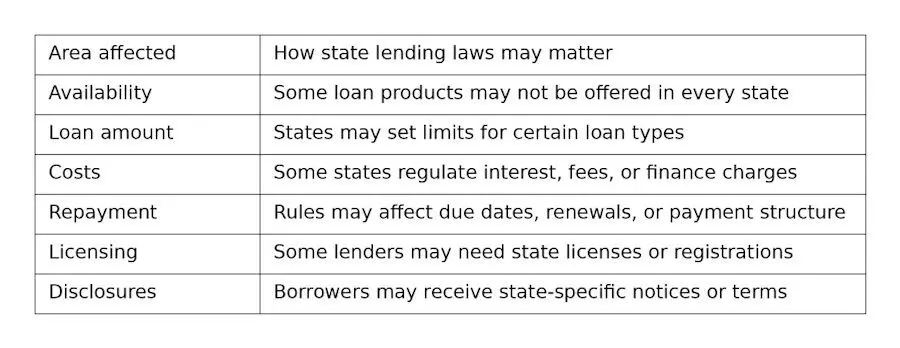
Availability is often the first thing borrowers notice. So let's look at why loan options change from one state to the next.
Why Does Online Loan Availability Change by State?
Not every lender serves every state. Loan products can also vary based on local rules. Some states have stricter consumer finance laws than others. As a result, you may see different terms depending on your location and eligibility. This is one reason lenders ask for your address and residency details.
If a lender does not offer a product in your state, it may be due to licensing rules, state lending requirements, product structure, or internal eligibility criteria. A missing option is not always about you. Sometimes the product simply isn't offered where you live. State rules are only part of the picture, though. Some online loans follow a different framework. That brings us to tribal lending.
What Should You Know About Tribal Lending vs State Lending?
Tribal lenders are connected to federally recognized tribes. Tribal lending vs state lending can be complex. Tribal lending can involve tribal law and federal consumer-finance requirements. The role of state law may vary based on the lender, transaction, borrower location, and applicable legal requirements.
These frameworks can interact in ways that are not always obvious. So don't assume every online loan follows the same state rules. Read the lender's disclosures, check state availability, and review repayment terms and total cost before you sign.
CreditCube operates in this space. Here is how its loans work.
How Do CreditCube and Tribal Installment Loans Work?
CreditCube is a tribal lender that offers tribal installment loans for eligible borrowers. СreditCube identifies itself as a tribal lender. Its lending activities are subject to applicable tribal and federal requirements. The relevance of state law may vary based on the transaction, borrower location, and applicable law. Unlike a traditional payday loan that may require repayment in one lump sum, an installment loan is repaid through scheduled payments according to the loan agreement.
Tribal installment loans are an expensive form of borrowing and can carry a high APR, so they are best suited to short-term needs rather than long-term financial gaps. Eligibility is reviewed before approval. Availability depends on your state, eligibility, lender review, and the final agreement.
Before you sign, review the full cost, payment schedule, and terms. This matters for any loan, whether the lender follows state or tribal rules. And speaking of rules, federal protections also play a part.
How Do State Lending Laws Compare to Federal Consumer Protection Rules?
Both can matter for the same loan. State lending laws may set state-level requirements. Federal consumer protection rules may apply across many consumer credit products. Federal rules can include disclosure requirements and protections against unfair, deceptive, or abusive practices. In plain terms: state rules may affect availability or product terms. Applicable federal consumer-finance laws can require specified credit disclosures and prohibit unfair, deceptive, or abusive acts or practices. Before accepting a loan, review the written disclosures for the APR, finance charge, payment schedule, total repayment amount, and other terms.
Knowing the rules helps. But before you apply, a short checklist helps even more.
What Do You Need to Check Before Applying Online?
Run through these questions before you apply. They cover the details that affect what you pay.
- Is the loan available in my state? Availability can change based on where you live.
- What type of loan is this? Ask if it's a payday loan, installment loan, line of credit, or something else.
- What is the APR? This is the yearly cost of the loan.
- What fees may apply? Look for origination, late, or other charges.
- What is the total repayment amount? This is what you pay back in full.
- What are the payment dates? Know when each payment is due.
- What happens if I miss a payment? Check the penalties and next steps.
- Is automatic payment required? Review whether the loan agreement includes recurring electronic-payment authorization and how payments are scheduled.
- Can I repay early? Ask whether early payoff is allowed and if there's a fee.
- Is the lender clear about eligibility and state availability? Vague answers are a warning sign.
- Are alternatives available? Compare other options before you commit.
Review CreditCube's loan terms and disclosures before applying. Different loan types can be affected by state rules in different ways. Here's a quick comparison.
How Do State Lending Laws Affect Payday, Installment, and Online Loans?
| Loan type | How state lending laws may affect it |
|---|---|
| Payday loans | Some states restrict, regulate, or prohibit certain payday loan structures |
| Installment loans | State rules may affect licensing, fees, loan size, and repayment terms |
| Online loans | Availability may depend on your state and the lender's legal structure |
| Tribal installment loans | Tribal law, federal rules, and state-level issues may interact differently by lender and location |
No single loan type is always safer or cheaper. Each depends on the terms and your situation. Sometimes, though, none of these show up as an option. Let's look at why.
Why Might an Online Loan Not Be Available in Your State?
- The lender does not serve that state. Some lenders limit where they operate.
- The loan type is restricted there. State rules may not allow that product.
- A lender may not offer a particular product in your state because of applicable legal requirements, product availability, or the lender’s business policies.
- You do not meet eligibility requirements. Each lender sets its own criteria.
- Internal underwriting criteria are not met. The lender reviews your details before approval.
- Availability may depend on applicable legal requirements, the lender’s service area, and the lender’s eligibility criteria.
A declined or unavailable application does not always mean you did something wrong. Sometimes the product simply isn't available based on state lending rules, lender criteria, or product structure.
Whatever loan you can access, borrowing wisely matters most. Here's how.
How Can You Borrow Responsibly Under State Lending Rules?
- Borrow only what you can repay. Match the loan to your budget.
- Compare total cost before signing. Look past the monthly payment to the full amount.
- Don't rely only on monthly payment size. A low payment can hide a high total cost.
- Understand payment dates. Know when money leaves your account.
- Avoid borrowing to fix long-term hardship. A loan rarely solves ongoing money trouble.
- Consider alternatives first. Other options may cost less.
Alternatives worth checking include payment plans with service providers, an employer paycheck advance, emergency savings, budget adjustments, nonprofit credit counseling, and credit union small-dollar loans. According to the Consumer Financial Protection Bureau and the Federal Trade Commission, comparing the total cost and reading disclosures carefully are key steps before you borrow.
If you're weighing CreditCube against other online options, here's a neutral look.
How Does CreditCube Compare to Traditional Online Loan Options?
| Feature | Traditional payday loan | CreditCube tribal installment loan |
|---|---|---|
| Repayment | Often one lump-sum payment | Scheduled installment payments |
| Availability | Varies by state and lender | Depends on eligibility and state availability |
| Cost | Can be expensive | Can also be expensive; review terms before signing |
| Approval | Not guaranteed | Not guaranteed |
| Best borrower action | Review terms and alternatives | Review terms and alternatives |
Both loan types can be expensive. Review the terms and compare alternatives before you decide. If you need cash fast for a pressing bill, our guide on urgent loans walks through the approval process.
Here's a quick recap of the main points.
Key Takeaways About State Lending Laws
- State lending laws can affect which online loans are available.
- Rules may vary by state and loan type.
- Lenders may ask for your state to check availability.
- Tribal lending vs state lending can be complex.
- CreditCube offers tribal installment loans for eligible borrowers.
- Approval, cost, terms, funding, and availability are not guaranteed.
- Borrowers should review total cost, payment schedule, and alternatives before signing.
FAQs - State Lending Laws
What are state lending laws?
State lending laws are rules that may affect how certain loans are offered in a state. They can address licensing, fees, loan amounts, repayment terms, disclosures, and borrower protections.
How do state lending laws affect online borrowing?
They may affect whether a lender can offer a loan in your state, what terms are available, what disclosures you receive, and which options appear online.
Why do online lenders ask what state I live in?
Loan availability, eligibility rules, licensing requirements, and disclosures can vary by location. Your state helps the lender show accurate options.
What does tribal lending vs state lending mean?
It refers to the difference between loans from tribal lenders and loans from lenders operating under state frameworks. Tribal lending can involve tribal law, federal consumer protection rules, and state-level considerations.
Is CreditCube available in every state?
Loan availability depends on state availability, eligibility, lender review, and the final agreement. Check current availability before applying.
Are tribal installment loans the same as payday loans?
No. Payday loans often involve short repayment windows and lump-sum repayment. Tribal installment loans are generally repaid through scheduled installments according to the loan agreement.
What should I check before signing an online loan agreement?
Check the APR, fees, total repayment amount, payment dates, missed-payment consequences, state availability, lender disclosures, and whether repayment fits your budget.
Recent Articles
AI Loan Approval Is Faster and You’ll Be Shocked How!
Discover how AI loan approval and automated underwriting are revolutionizing...Hardship Loans for Bad Credit: Options, Rates, and Risks
Hardship loans for bad credit explained. Learn how they work, who qualifies,...Quick Personal Loans Guide: Approval, Costs, Options
Quick personal loans explained. Learn how they work, who qualifies, costs, a...$500 Payday Loans Online Same Day - Fast Cash Guide
$500 payday loans online same day explained. Learn how they work, requiremen...Short Term Personal Loans: Compare Options in 2026
Short term personal loans explained with lender options, costs, and tips to ...Emergency Car Repair Loans: Fast Help for Urgent Repairs
Emergency car repair loans explained. Learn costs, approval factors, risks, ...Get your money today
Apply for a loan NOW!
Applying does NOT affect your FICO® Score!
Have questions?
Please call us by phone:
Credit Cube © 2026. All rights reserved
CreditCube is a Tribal enterprise, wholly owned and operated by the Big Valley Band of Pomo Indians, a federally-recognized American Indian tribe and sovereign government. Any Agreement entered into as a result of this Application shall be governed by applicable Tribal and federal law. Each aspect of communication and transaction with/on this site will be deemed to have occurred in CreditCube’s Big Valley Band of Pomo Indian Reservation offices, regardless of the location where you are accessing or viewing this site.
⚠ Please note: This is an expensive form of borrowing. CreditCube loans are designed to assist you in meeting your short-term borrowing needs and are not intended to be a long-term financial solution! Examples of emergency reasons why these loans might be used include unexpected emergencies, car repair bills, medical care, or essential travel expenses.
* Loan approvals are subject to underwriting. Approval may take longer if additional verification documents are requested. Not all loan requests are approved. CreditCube reviews your information in real-time to determine whether your information meets our lending criteria. You acknowledge that by completing and submitting the website application that you are applying for a Loan. We verify applicant information through national databases including, but not limited to, Clarity Services, Inc., a credit reporting agency, and we may pull your credit in order to determine your eligibility and ability to repay.
** Maximum loan amount is $500 for first-time customers. For returning CreditCube customers, rates may go down over time based on your CreditCube Loyalty Program status and your payment history with us. Please see our Loyalty Program page for more information.
*** Loan Applications processed and approved before 3pm EST Monday-Friday are typically funded on the next business day. Example: If your loan is processed and approved on Friday before 3pm EST, the loan will typically be funded on the following Monday. Deposit times may vary depending on your bank. Business Day means Monday through Friday excluding all federal banking holidays.
CreditCube does not lend to residents of Pennsylvania, Connecticut, Minnesota, New York, Vermont, Virginia, West Virginia, Illinois, Georgia and North Carolina. Availability of installment loans in your state is subject to change at any time with or without notice at the sole discretion of CreditCube.