Loan Repayment Schedule: A Simple Guide to Reading Yours

Reading a loan repayment schedule comes down to one habit: look at it closely before you sign. The schedule shows how a loan is paid back over time. It lays out your installments, due dates, and the total you will repay. For personal loans, it also shows how each payment chips away at the balance.
That view helps you plan your budget with confidence. CreditCube is one lender whose borrowers get this schedule in their agreement, though approval and terms are never guaranteed. This guide explains what the schedule shows and what to check.
What Is a Loan Repayment Schedule?
A loan is money you borrow and pay back over time. A loan repayment schedule is the plan for paying it back. It is usually a table that maps out every payment from first to last. The schedule answers the basic questions. A payment schedule shows the number, amounts, and timing of scheduled payments. An amortization table, if provided, may also show the principal and interest allocation and remaining balance. Review the separate loan disclosures for APR, finance charge, and total of payments.
Costs live in the schedule too. The APR, or annual percentage rate, states interest and some fees as a yearly rate. Terms like principal and interest get a full glossary a little further down. First, here is why the schedule matters so much.
Why Does a Loan Repayment Schedule Matter?
A repayment schedule turns a loan from a guess into a plan. It shows how much you will pay and for how long. That makes it easier to budget each payment and see when the debt ends. It also helps you compare offers. Line up two schedules, and the loan that costs less and fits better stands out. You can see whether a payment works for your budget before you agree to it. Even a small 1000 Loan is worth this check.
Most of all, the schedule prevents surprises. Read it while you can still walk away, before the loan is active. If the numbers look too high for your situation, that is useful to learn early. Next, here is how a general schedule differs from a personal loan version.
Loan Repayment Schedule vs. Personal Loan Repayment Schedule
The two terms sound alike, and they do overlap quite a bit. The difference comes down to scope. A loan repayment schedule is the general plan for repaying any kind of loan, while a personal loan repayment schedule is that same plan built specifically for a personal loan, usually with fixed installments over a set term.
The total of payments is the amount you will have paid after making all scheduled payments, including repayment of principal. Review the finance charge for the disclosed dollar cost of credit, and check separately for additional or contingent charges.
That focus tends to make personal loan schedules easier to follow. With quick personal loans, for instance, the schedule is often short and simple. Either way, the terms on the page are the same, and the table below defines the ones you will run into most.
| Term | Meaning |
|---|---|
| Loan repayment schedule | General schedule showing payment timing and repayment structure |
| Personal loan repayment schedule | Schedule for a personal loan, usually with installment payments |
| Installment | A scheduled payment made over time |
| Principal | The amount borrowed, or the balance that remains |
| Interest | The cost charged for borrowing |
| Fees | Extra charges named in the loan agreement |
| Total repayment amount | The full amount you may repay over the life of the loan |
With the terms defined, installments deserve a closer look.
Understanding Installments in a Repayment Schedule
Understanding installments comes down to four questions: how much is due, when it is due, what the payment covers, and how it changes your balance. An installment is simply one scheduled payment on the plan. Most cover both principal and interest, and sometimes a fee on top.
The exact amount and timing live in your agreement, so that is the place to check them. Look closely at each due date and see how it lines up with your income cycle. A payment that lands right after payday is far easier to make than one that falls the week before. Once the timing works, confirm the installment fits your budget before you commit.
It also helps to know the downside in advance. Missed installments carry consequences, which may include added charges or effects on your account. Ask the lender what happens if a payment is late, so nothing catches you off guard. With the installments clear, here is a step-by-step way to read the whole schedule.
Step by Step Reading of a Loan Repayment Schedule
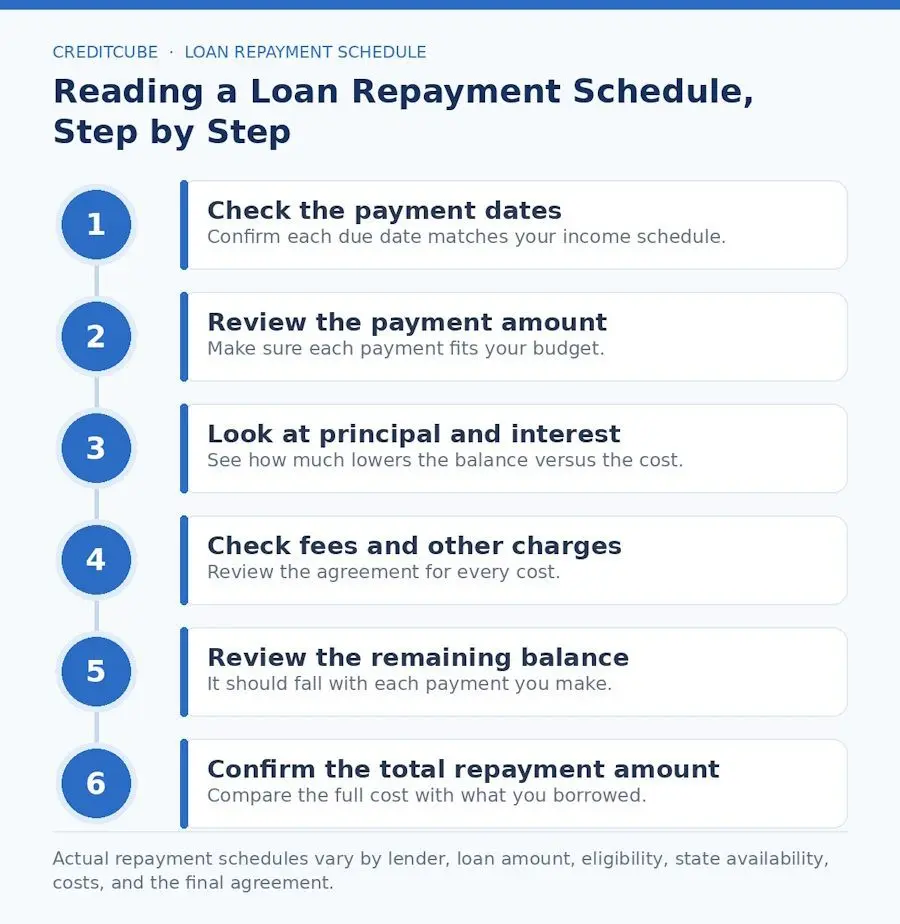
The schedule looks busy at first, but it reads in a clear order. Work through it one column at a time.
- Check the payment dates. Look at when each payment is due. Confirm the dates match your income schedule, whether they fall weekly, biweekly, or monthly.
- Review the payment amount. Confirm how much is due each time. Check whether the amount stays the same, and make sure it fits your budget.
- Look at principal and interest. Principal lowers your balance, while interest is the cost of borrowing. In many amortizing loans, more of the early payment goes to interest, a pattern the CFPB explains in its guide to the amortization schedule.
- Check fees and other charges. Fees should be spelled out, so do not assume each payment is only principal and interest. Review the agreement for every cost.
- Review the remaining balance. For a fully amortizing loan, making each scheduled payment in full and on time generally reduces the principal balance. Check how payments are allocated under your agreement. If it does not drop as expected, read the terms again.
- Confirm the total repayment amount. This may be the most important number on the page. It shows the full cost of the loan, so compare it with the amount you borrowed.
Checklist Before Signing a Personal Loan Agreement
A few minutes with this checklist can save you trouble later. Go through each question before you sign.
- Payment dates. Do you know when each payment is due?
- Installment amount. Do you know how much each payment is?
- Total repayment amount. Do you know the full amount you will repay?
- Costs. Do you understand the APR, fees, and other charges?
- Missed payments. Do you know what happens if you miss one?
- Income fit. Does the schedule line up with how you get paid?
- Essentials. Can you still cover rent, utilities, food, insurance, and transport while you pay?
- Alternatives. Have you compared other options?
- The full agreement. Have you read all of it, not just the summary?
One item on that list, the loan term, shapes the whole schedule.
What Your Loan Term Does to the Repayment Schedule
The loan term is simply how long you have to repay, and it shapes two things at once: your payment and your total cost. A shorter term usually means larger payments, since you clear the balance faster. For the same loan amount and interest rate, with comparable fees and repayment structures, a shorter term generally means larger payments and less total interest. Compare the actual offers rather than the term alone.
A longer term works the other way. Each scheduled payment may be smaller and easier to manage, yet you stay in debt longer and can pay more by the end. That trade-off is why neither path is right for everyone.
The way to decide is to look at two numbers side by side: the installment amount and the total repayment amount. The first tells you what you can handle each month, and the second tells you the full cost of the loan. Weigh them together before you choose a term.
Common Mistakes to Avoid When Reading a Loan Repayment Schedule
Most mistakes come from reading too fast. These are the ones to avoid.
- Watching only the payment. A low monthly payment can still hide a high total cost.
- Ignoring the total repayment amount. This is the number that shows what the loan really costs.
- Skipping the payment dates. A due date that misses payday can lead to a late payment.
- Missing the fees. Charges beyond principal and interest add up.
- Assuming all loans match. Terms and structures differ from one lender to the next.
- Overlooking missed-payment terms. Know the cost of a late payment before you sign.
- Forgetting future income. Make sure the schedule still works if your income changes.
- Not reading the final agreement. The agreement, not the summary, is what binds you.
Reading well is easier once you know where CreditCube fits in.
CreditCube and Loan Repayment Schedules
At CreditCube, approved borrowers receive a loan agreement that lays out the repayment terms in full. It covers the scheduled installments, the payment dates, the costs, and the other details that shape what you owe.
CreditCube offers tribal installment loans, not payday loans, so repayment follows a set schedule rather than a single due date. These loans can be expensive, though, so review the whole schedule and confirm the payments fit your budget before you sign. APRs range between 200% and 700%.
As with any lender, nothing here is promised in advance. Approval, loan amount, repayment terms, payment schedule, costs, funding timing, and availability all depend on your eligibility, state availability, lender review, bank processing, and the final agreement. If this route fits your needs, review CreditCube's installment loan option and loan terms closely before you apply.
Top Alternatives to Personal Loans
A loan is only one way to cover a cost, and it's rarely the only one worth a look. Before you borrow, take a moment to see what else is on the table. A few of these options cost less than a loan, and some cost nothing at all.
- Provider payment plans. Many service providers, from clinics to utility companies, let you spread a bill over several months. Ask about it before you assume a loan is the only route.
- Emergency savings. If you have money set aside, tapping it covers the cost without adding new debt. Just make sure using it won't leave you short for another emergency.
- Budget adjustments. Trimming other spending for a while may free up what you need. Even a short pause on non-essentials can close a small gap.
- Employer paycheck advance. Some employers will advance part of your next check, often with no fee. Check with HR or your manager to see if it's an option.
- Family or community help. Support from family or a local program may carry no interest at all. A frank conversation can be easier than taking on a loan.
- Nonprofit credit counseling. A counselor can help you build a plan and weigh your choices for little or no cost. This is a good first step if debt already feels heavy.
- Waiting or trimming the expense. If the cost is not urgent, delay it or scale it back. Time gives you room to save and avoid borrowing altogether.
Weigh the cost and timing of each before you decide. If a loan still looks like the best fit, run one last check on yourself.
7 Questions to Ask Yourself Before Borrowing
Before you use any loan, it helps to pause and think it through. A few honest questions can tell you whether borrowing is the right call. Run through this short list first.
- Is the expense necessary? Borrow for real needs, like a car repair or a medical bill. Wants that can wait are worth putting off until you save for them.
- Is the repayment schedule clear? You should understand every payment before you sign. If any part is fuzzy, ask the lender to walk you through it.
- Can you afford each installment? The payment should fit your budget with room to spare. A tight fit leaves no cushion if money gets short.
- What is the total cost? Look at the full amount you will repay, not just the monthly figure.
- What if you miss a payment? Know the consequences ahead of time. Late fees and other effects can add up fast.
- Is there a lower-cost option? Check the alternatives before you commit. A payment plan or savings may cost you less.
- Is this for a temporary need? A loan works best for a one-time expense. It should not patch an ongoing money problem that keeps coming back.
If you can answer these with confidence, you are in a good spot to move forward.
Conclusion
A loan repayment schedule is the clearest picture of what a loan will cost you. In one table, it shows your payment timing, your installment amounts, the total cost, and how the balance falls with each payment. That is a lot of insight for a single page, so read it while you still have the choice to walk away.
For a personal loan, the same schedule doubles as a budgeting tool, as long as the payment fits your situation. So if you borrow from CreditCube, take the time to review the full agreement and confirm the repayment terms are clear. A few minutes of reading now can protect your budget for months to come.
FAQs About Loan Repayment Schedules
What is a loan repayment schedule?
A loan repayment schedule is a plan, usually a table, that shows when payments are due, how much you owe each time, and how the balance changes over the life of the loan.
What is included in a personal loan repayment schedule?
It may show payment dates, installment amounts, principal, interest, fees, the total repayment amount, and the remaining balance after each payment.
What does understanding installments mean?
It means knowing how much each payment is, when it is due, what it covers, and how it affects the balance you still owe.
Why does more of my payment go toward interest at first?
In many amortizing loans, the balance is highest at the start, so more of each early payment goes to interest. As the balance falls, more of each payment goes toward principal.
What should I check before signing a loan agreement?
Check the payment dates, installment amounts, APR, fees, total repayment amount, remaining balance, missed-payment terms, and whether the schedule fits your budget.
Can a repayment schedule change?
It depends on the agreement. Read yours closely, and contact the lender with any questions about payment timing, amounts, or possible changes.
Is CreditCube a payday loan?
No. CreditCube offers tribal installment loans. Approved borrowers repay through the scheduled installments listed in their final agreement.
Recent Articles
Installment Loans vs Payday Loans: Which Is Safer and Smarter in 2026
Compare installment loans vs payday loans in 2026 explore risks, benefits, r...Cash Advance App Fees: What They Really Cost
Cash advance app fees can hide more than one charge. Learn the full cost, re...Loan With 500 Credit Score: Approval Options
Loan with 500 credit score options explained. Learn how to qualify faster, w...Same Day Loan Funding Explained | ACH vs Wire Transfers
Same day loan funding explained. Learn how ACH, wire transfers, and bank pro...Quick Loans in 2026: How to Apply and Get Approved Fast
Quick loans guide for 2026. Learn how to apply, approval steps, requirements...Installment Loans Plano TX: Funding Timelines
Installment loans, personal loans, payday loans in Plano TX: see what shapes...Get your money today
Apply for a loan NOW!
Applying does NOT affect your FICO® Score!
Have questions?
Please call us by phone:
Credit Cube © 2026. All rights reserved
CreditCube is a Tribal enterprise, wholly owned and operated by the Big Valley Band of Pomo Indians, a federally-recognized American Indian tribe and sovereign government. Any Agreement entered into as a result of this Application shall be governed by applicable Tribal and federal law. Each aspect of communication and transaction with/on this site will be deemed to have occurred in CreditCube’s Big Valley Band of Pomo Indian Reservation offices, regardless of the location where you are accessing or viewing this site.
⚠ Please note: This is an expensive form of borrowing. CreditCube loans are designed to assist you in meeting your short-term borrowing needs and are not intended to be a long-term financial solution! Examples of emergency reasons why these loans might be used include unexpected emergencies, car repair bills, medical care, or essential travel expenses.
* Loan approvals are subject to underwriting. Approval may take longer if additional verification documents are requested. Not all loan requests are approved. CreditCube reviews your information in real-time to determine whether your information meets our lending criteria. You acknowledge that by completing and submitting the website application that you are applying for a Loan. We verify applicant information through national databases including, but not limited to, Clarity Services, Inc., a credit reporting agency, and we may pull your credit in order to determine your eligibility and ability to repay.
** Maximum loan amount is $500 for first-time customers. For returning CreditCube customers, rates may go down over time based on your CreditCube Loyalty Program status and your payment history with us. Please see our Loyalty Program page for more information.
*** Loan Applications processed and approved before 3pm EST Monday-Friday are typically funded on the next business day. Example: If your loan is processed and approved on Friday before 3pm EST, the loan will typically be funded on the following Monday. Deposit times may vary depending on your bank. Business Day means Monday through Friday excluding all federal banking holidays.
CreditCube does not lend to residents of Pennsylvania, Connecticut, Minnesota, New York, Vermont, Virginia, West Virginia, Illinois, Georgia and North Carolina. Availability of installment loans in your state is subject to change at any time with or without notice at the sole discretion of CreditCube.