Loan Identity Verification: How Third-Party Screening Works

Loan identity verification allows online lenders to confirm applicant identity prior to loan approval. Third-party screening services support this process by validating details and flagging inconsistencies.
At CreditCube, a tribal installment lender, applicant information may be reviewed with help from outside services that verify identity and support eligibility checks, much like a lender would during a bank statement loan review. This step can catch inconsistencies, lower the risk of fraudulent applications, and protect both borrowers and lenders. It cannot remove every identity theft risk, so it works best as one layer of protection.
In this article, we take a look at how screening works, what different providers check, and what you can do when extra verification is needed.
Why Loan Identity Verification Matters Before Approval
Loan identity verification matters because it confirms that the person applying is the real account holder, not someone using stolen details. Online loan applications can attract identity theft, where a fraudster submits an application using another person’s personal information. A good check also catches incorrect or inconsistent applicant details and flags account activity that looks suspicious. For lenders, an independent screening tool adds a layer of review that helps lenders confirm applicant information and reduce fraud risk.
It helps to separate two ideas here. Loan identity verification confirms who you are, and that is a different question from your creditworthiness or your ability to repay. A lender judges those separately, using its own review. Accurate verification simply protects the integrity of the application, which benefits honest borrowers as much as it benefits the lender.
How CreditCube Reviews Your Loan Identity During an Application
CreditCube reviews your loan identity through a clear application process, from the moment you submit your details to the final lending decision. The steps below show what usually happens and where verification fits in.
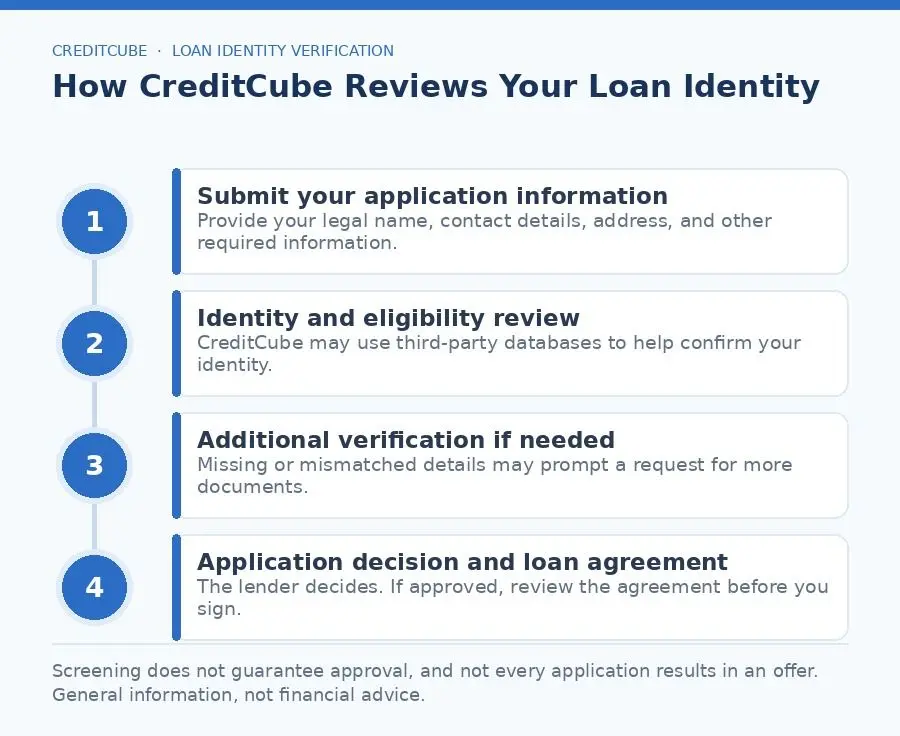 1. Submit your application information. You provide details such as your legal name, contact information, address, and other required information. Accurate entries here help the review start smoothly.
2. Identity and eligibility review. CreditCube may review your application information and use third-party databases to help confirm your identity. This is also where eligibility factors come into the picture.
3. Additional verification if needed. Missing or inconsistent information may lead to a request for more detail or supporting documents. This does not mean something is wrong, since small mismatches are common.
4. Application decision and loan agreement. The lender decides the outcome, and approval is never automatic. If you are approved, review the loan agreement, APR, fees, repayment schedule, and obligations before you sign.
Screening supports overall evaluation but does not guarantee loan approval or specify processing times. Additional documentation may be requested, and approval remains subject to full underwriting review.
How E-HAWK and Clarity Services Support Loan Identity Screening
E-HAWK and Clarity Services are two third-party services that lenders may use to support loan identity screening, and they do different jobs. People searching for “E-hawk Clarity screening” are often looking at two separate tools: one focuses on digital fraud risk, and the other on consumer data and verification. Understanding each one makes the screening process easier to follow.
E-HAWK: Identifying suspicious digital activity. Based on publicly available E-HAWK documentation, this type of service reviews signals around how and where an application is submitted. It may look at IP address risk signals, email reputation, device fingerprinting, phone-related risk indicators, and repeated or unusual signup activity. These signals can reveal patterns that may need a closer look. A fraud-risk signal does not necessarily mean an applicant has done anything wrong, since honest people can trigger them too. You can read more about this provider at ehawk.net.
Clarity Services: Consumer data and verification support. Clarity Services is part of Experian, and it offers consumer reporting along with alternative financial services information. A lender may use it to review identity and application information, pull consumer reporting data, run credit-related screening, and support fraud identification. The goal is to give lenders more context when they assess an application. Clarity Services does not itself approve or deny a CreditCube loan application, since that decision stays with the lender. You can learn more at clarityservices.com and through Experian’s alternative financial services page.
| Screening provider | What it may review | Primary purpose |
|---|---|---|
| E-HAWK | IP, device, email, phone, and activity patterns | Detect potentially suspicious digital behavior |
| Clarity Services | Consumer reporting data and identity-related information | Support verification, fraud review, and lending assessments |
Lenders may use either or both screening providers depending on their evaluation process. Note that Clarity Services serves as an information source and does not render final loan decisions.
What Information Can Loan Identity Screeners Check?
Loan identity screeners can check several categories of information, depending on the lender and the service. The point is to confirm who you are and to spot details that do not line up. The table below shows common categories and why each one may be reviewed.
| Information category | Reason for review |
|---|---|
| Name and address | Identify possible mismatches |
| Date of birth and identity details | Help validate applicant information |
| Phone and email | Detect inconsistencies or suspicious signals |
| IP address and device information | Identify potential digital fraud risks |
| Consumer reporting information | Support credit or eligibility assessments where applicable |
Not every lender or service checks every field, and lenders share applicant information with service providers as described in their privacy notices and as permitted by applicable law.
What Happens When Loan Identity Verification Finds a Mismatch?
When loan identity verification finds a mismatch, it may lead to a request for more information rather than an automatic denial. The lender may ask you to correct the information, complete additional identity verification, or send supporting documents. In some cases, the application goes to manual review, and in others it may be delayed or declined. The outcome depends on the details and how quickly they are resolved.
How to respond to an identity verification request. First, check that your application details are correct, since a small typo can cause a mismatch. Confirm that the request comes from the lender through an official channel before you share anything. Then provide accurate information using the lender’s authorized process, and contact customer support if any part of the request is unclear.
Here is a simple example. Imagine an applicant whose current address does not match the address on file for verification, because they moved recently. Correcting that innocent mistake, or providing a document that shows the new address, may help resolve the inconsistency. Even then, a correction does not promise a particular outcome, since the lender still completes its full review.
Does Loan Identity Verification Affect Your Credit Score?
Loan identity verification and credit evaluation are not always the same process, so one does not automatically change your score. A lender may use consumer reporting agencies during its review, and whether an inquiry affects your credit score depends on the type of inquiry and how it is reported. The clearest way to know is to review the lender’s credit authorization and disclosures before you apply.
If a consumer reporting service like Clarity is involved, you have rights worth remembering. You can request information about your Clarity report and dispute anything that looks inaccurate. If a lender denies your application based in whole or in part on information in a consumer report, it must tell you which consumer reporting agency provided the report, and you can request a free copy of that report within 60 days. The CFPB maintains a page about Clarity Services that explains how to do this, which is a helpful starting point.
How to Protect Your Loan Identity When Applying Online
Protecting your loan identity online comes down to applying carefully and guarding your personal information. A few habits make a real difference:
- Apply through the lender’s official website.
- Check the website address before you provide any information.
- Avoid sending sensitive documents through unsolicited links.
- Use strong passwords and protect your email account.
- Review your credit reports for unfamiliar accounts.
- Consider a fraud alert or a credit freeze if you suspect identity theft. A fraud alert placed with one of the three nationwide credit bureaus is shared with the other two, while a credit freeze is free and is placed with each bureau separately. You can also report identity theft and get a recovery plan at IdentityTheft.gov.
- Contact the lender as soon as you notice suspicious activity.
Third-party verification is one layer of protection, not a guarantee against identity theft, so these habits still matter. If you are comparing offers, look at the full cost of any option, including products like quick personal loans, before you apply. The CFPB also publishes guidance on what to do if you become a victim of identity theft.
Why CreditCube Uses Identity and Eligibility Checks
CreditCube uses identity and eligibility checks because it reviews applications rather than promising automatic approval. As a tribal installment lender, it relies on these checks to help verify information and assess eligibility, and third-party screening can support fraud detection. The review may also consider income, credit information, repayment ability, and other factors, and the final decision rests with the lender.
A properly completed application helps CreditCube assess the information you submit, though accuracy alone does not guarantee approval. If you want to understand the product first, it helps to compare options such as cash advance vs installment loan so you know what you are applying for.
Learn how CreditCube reviews applications, and check the terms, before you begin.
What to Consider Before Completing a Loan Application
Before completing a loan application, it helps to pause and ask a few honest questions.
- Is the lender’s identity clear?
- Have you reviewed its privacy information, and do you understand what information may be collected?
- Do you know the APR and the total repayment cost, and can you afford the scheduled payments?
It is also worth asking whether you have considered alternatives to borrowing, such as a payment plan with the biller, an employer paycheck advance, help from a local assistance program, or using emergency savings if you have them.
CreditCube installment loans are an expensive form of borrowing, and they may not be the right fit for every financial situation. If money is tight, other options, such as hardship loans, may be worth comparing first, since some may cost less depending on the lender.
Sum Up
Third-party screening helps lenders detect suspicious activity and verify the information on an application. E-HAWK and Clarity Services perform different jobs, with one focused on digital fraud risk and the other on consumer data. Screening reduces certain risks, but it cannot guarantee full protection against identity theft.
CreditCube reviews application information before making any lending decision, and you should review your borrowing costs and terms with the same care. Review CreditCube’s installment loan application process, eligibility requirements, and loan terms before deciding whether to apply.
Frequently Asked Questions About Loan Identity Verification
What is loan identity verification?
Loan identity verification is how lenders check applicant information to confirm identity and spot inconsistencies. It usually reviews details such as your name, address, and contact information. The goal is to make sure the person applying is really you.
Why do online lenders use third-party identity screeners?
Online lenders use third-party screeners to tap external databases and run independent checks. These services help verify applicant information and assess fraud risk. That extra review helps lenders confirm applicant information and reduce fraud risk.
What is the difference between E-HAWK and Clarity screening?
E-HAWK focuses on digital fraud-risk signals, such as IP, device, and email activity. Clarity Services focuses on consumer reporting and identity-related information. They serve different purposes, and a lender will not necessarily use both.
Does loan identity verification affect my credit score?
Identity checks and credit inquiries are not the same thing. Identity verification confirms who you are, while a credit inquiry reviews your credit. Whether your score changes depends on the type of check the lender performs and how it is reported.
Why is my loan application still pending after identity verification?
Verification is only one part of the review. A lender may still need to confirm eligibility or request more documents before deciding. A pending status often means the application is simply still in progress.
What happens if the lender cannot verify my identity?
If a lender cannot verify your identity, it may ask for more information, review your application manually, or decline it. Providing accurate details through the official channel gives you the best chance to resolve the issue.
How can I protect myself from loan identity theft?
Protect yourself by checking your credit reports regularly and watching for unfamiliar accounts. Apply only through official lender websites, and contact the lender if something looks wrong. You can also consider fraud alerts or credit freezes if you suspect theft.
Recent Articles
Cash Advance App Fees: What They Really Cost
Cash advance app fees can hide more than one charge. Learn the full cost, re...Personal Loans Orlando: How to Streamline Your Application
Personal loans Orlando borrowers can prepare for by gathering the right docu...Personal Loan Hialeah FL: Funding Timelines Explained
Getting a personal loan in Hialeah, FL? Learn what affects funding timelines...Otter Lending Alternatives for Fast Loans
Need a quick loan? Check out the best Otter Lending alternatives like Rise C...UDAAP Regulations: A Compliance Guide for Lenders
UDAAP regulations explained: what unfair, deceptive, and abusive practices m...Home Improvement Loans With Bad Credit: 2026 Guide
Home improvement loans with bad credit explained. Learn options, rates, and ...Get your money today
Apply for a loan NOW!
Applying does NOT affect your FICO® Score!
Have questions?
Please call us by phone:
Credit Cube © 2026. All rights reserved
CreditCube is a Tribal enterprise, wholly owned and operated by the Big Valley Band of Pomo Indians, a federally-recognized American Indian tribe and sovereign government. Any Agreement entered into as a result of this Application shall be governed by applicable Tribal and federal law. Each aspect of communication and transaction with/on this site will be deemed to have occurred in CreditCube’s Big Valley Band of Pomo Indian Reservation offices, regardless of the location where you are accessing or viewing this site.
⚠ Please note: This is an expensive form of borrowing. CreditCube loans are designed to assist you in meeting your short-term borrowing needs and are not intended to be a long-term financial solution! Examples of emergency reasons why these loans might be used include unexpected emergencies, car repair bills, medical care, or essential travel expenses.
* Loan approvals are subject to underwriting. Approval may take longer if additional verification documents are requested. Not all loan requests are approved. CreditCube reviews your information in real-time to determine whether your information meets our lending criteria. You acknowledge that by completing and submitting the website application that you are applying for a Loan. We verify applicant information through national databases including, but not limited to, Clarity Services, Inc., a credit reporting agency, and we may pull your credit in order to determine your eligibility and ability to repay.
** Maximum loan amount is $500 for first-time customers. For returning CreditCube customers, rates may go down over time based on your CreditCube Loyalty Program status and your payment history with us. Please see our Loyalty Program page for more information.
*** Loan Applications processed and approved before 3pm EST Monday-Friday are typically funded on the next business day. Example: If your loan is processed and approved on Friday before 3pm EST, the loan will typically be funded on the following Monday. Deposit times may vary depending on your bank. Business Day means Monday through Friday excluding all federal banking holidays.
CreditCube does not lend to residents of Pennsylvania, Connecticut, Minnesota, New York, Vermont, Virginia, West Virginia, Illinois, Georgia and North Carolina. Availability of installment loans in your state is subject to change at any time with or without notice at the sole discretion of CreditCube.