Emergency Expenses: How Do You Fund an Appliance Replacement?

When an essential appliance breaks, the cost can quickly become one of those emergency expenses you did not plan for. CreditCube offers tribal installment loans for eligible borrowers who want to review a funding option, but a loan is only one path. It should be compared with other appliance replacement funding alternatives before you apply. If you need a short-term gap covered, options like short term personal loans are one place people look.
Major appliances are among the larger, less frequent purchases households make, which is part of why they are easy to be caught off guard by, according to the U.S. Bureau of Labor Statistics Consumer Expenditure Survey. This guide explains how to evaluate your choices, what to check before borrowing, and when replacement makes more sense than repair.
When Does an Appliance Failure Become an Emergency Expense?
Not every broken appliance is an emergency. A failure becomes more serious when it affects food storage, basic hygiene, heating, cooling, cooking, or your ability to manage daily household needs.
A few common situations raise the stakes. A broken refrigerator can put food safety at risk within hours. A failed washer or dryer creates real strain in a household that depends on daily laundry. An oven or stove failure matters when cooking at home is essential, not optional. Water heater or HVAC-related appliance problems can affect comfort and health, especially in very hot or very cold weather. In each case, the issue is not the appliance itself. It is the basic need the appliance supports.
Once you decide the failure is urgent, the next step is to understand what it will actually cost.
What Costs Should You Review Before Choosing Appliance Replacement Funding?
The real need is often larger than the sticker price of a new unit. Before you choose any funding path, add up the full cost.
Common costs to review include a diagnostic fee to identify the problem, the repair estimate itself, and delivery of a new appliance. You may also face an installation fee, a haul-away fee for the old unit, and the cost of a warranty or protection plan. Energy efficiency differences can change what you pay over time. A less efficient model may cost less today but more each month. Temporary replacement costs, like eating out while a stove is down, add up quietly. Finally, weigh the cost of delaying the purchase against the cost of acting now.
A short checklist can help you decide how much you really need:
- Can the appliance be repaired safely?
- Is replacement cheaper than repeated repairs?
- Is the appliance essential?
- Is there a lower-cost model that meets the need?
- Can the expense wait until the next paycheck?
- Can the seller offer a payment plan?
With a clear number in mind, you can weigh the biggest decision of all: repair or replace.
Repair or Replace? How Should You Decide Before Borrowing?
Deciding between repair and replacement before you borrow can save you from funding the wrong choice. The goal is to solve the underlying need at the lowest reasonable cost. Repair may make sense when the appliance is newer and the repair cost is manageable. It also helps when parts are available, the appliance is otherwise reliable, and the repair actually solves the core issue rather than delaying the next breakdown.
Replacement may make sense when repairs are becoming frequent, or when repair costs approach the price of a new unit. It is also worth considering when the appliance is unsafe, when it is essential and cannot be delayed, or when poor energy use and performance are creating ongoing costs.
The right answer is not to borrow by default. It is to compare repair, replacement, and funding choices, then pick the one that fits your budget. Once you know whether you are repairing or replacing, you can look at how to fund it.
What Are the Appliance Replacement Funding Options for Emergency Expenses?
Several funding options exist, and each carries a different trade-off. The table below outlines the main choices so you can compare them side by side.
| Funding option | How it works | Key consideration |
|---|---|---|
| Emergency savings | Use available savings to cover repair or replacement | May avoid debt, but can reduce your emergency cushion |
| Payment plan | Retailer, repair company, or utility provider lets you pay over time | Review fees, due dates, and missed-payment rules |
| Credit card | Pay upfront and repay through card billing | Interest may apply if not paid in full |
| 0% promotional card | Promotional financing for qualified applicants | Deferred interest or fees may apply if terms are not met |
| BNPL | Split a purchase into several payments | Missed payments and overuse can create budget pressure |
| Employer advance | Early access to earned wages where available | Reduces future paycheck amount |
| Family or friend support | Informal help from someone you know | Should be handled clearly to avoid conflict |
| CreditCube installment loan | Tribal installment loan option for eligible borrowers | Review total cost, repayment schedule, and agreement before signing |
No single option is right for everyone. The best choice depends on how much you need, how quickly you can repay, and how each option affects the rest of your budget. If a loan is one of the paths you are weighing, it helps to understand how CreditCube fits.
How May CreditCube Help With Emergency Expenses?
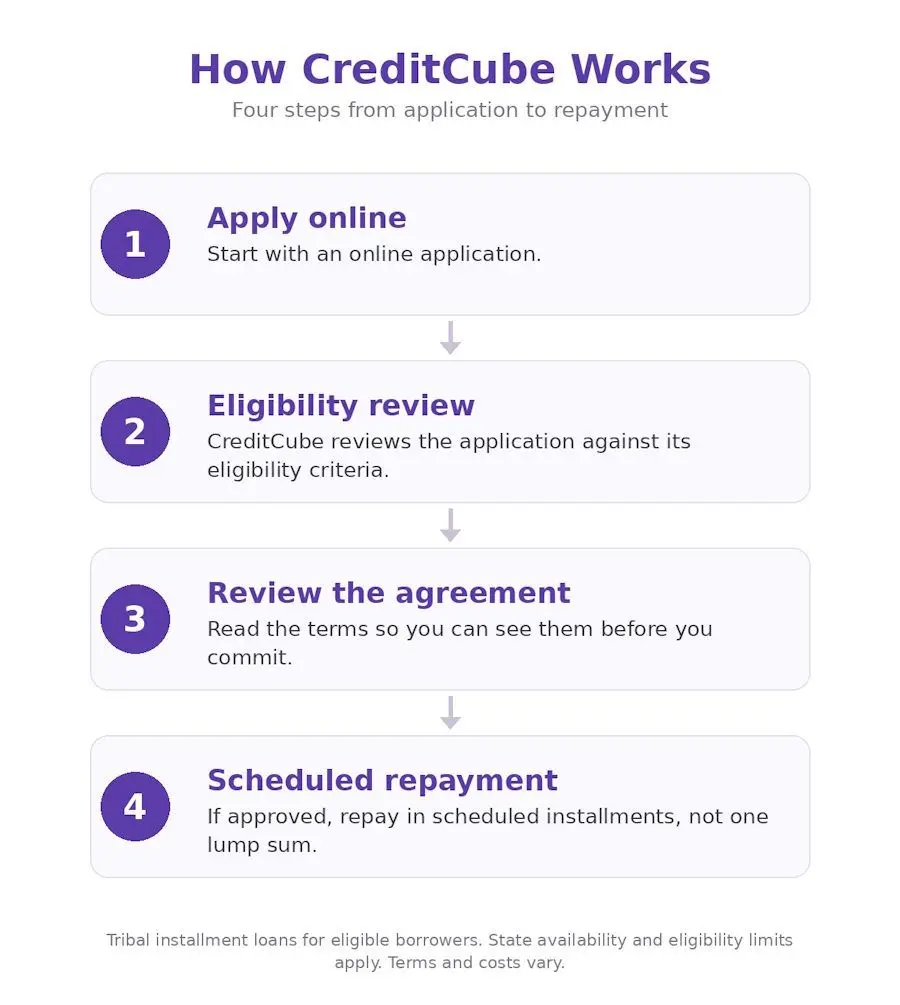
CreditCube offers tribal installment loans for eligible borrowers. If you are reviewing appliance replacement funding for emergency expenses, CreditCube may be one of the options to consider. However, note that CreditCube loans can carry high APRs that vary by borrower and state; review your loan agreement for the exact APR and total cost. If approved, repayment is made through scheduled installments according to the loan agreement.
- Apply online. Start with an online application.
- Eligibility review. CreditCube reviews the application against its eligibility criteria.
- Review the agreement. Before anything is final, you review the terms so you can see them before you commit.
- Scheduled repayment. If approved, repayment follows a scheduled installment structure rather than a single lump sum.
State availability and eligibility limits apply, and terms and costs vary by borrower and situation. Installment loans are an expensive form of borrowing, so it is worth comparing the total cost against your other options before you decide.
Whatever funding path you lean toward, there are specific details you should confirm before you apply.
What Should You Check Before Applying for Appliance Replacement Funding?
Before you sign anything, make sure you understand the full picture. The details below matter as much as the amount you borrow.
Check the total repayment amount, the APR and fees, and the payment dates. Confirm the loan term and understand what happens if a payment is missed. Verify state availability, since some products are not offered everywhere. Then step back and confirm the purchase itself makes sense: whether the appliance is truly essential, whether repair is possible, whether repayment fits your monthly budget, and whether lower-cost alternatives are still on the table.
A quick self-check before you commit:
- I know the exact appliance cost.
- I compared repair and replacement.
- I reviewed delivery, installation, and haul-away fees.
- I checked payment plans or lower-cost alternatives.
- I understand the repayment schedule.
- I can make payments without missing essentials.
- I reviewed the full agreement before signing.
If a loan is still in the running, it helps to see how it compares to more traditional funding routes.
How Does CreditCube Compare to Traditional Appliance Funding Alternatives?
Different funding routes suit different situations. This neutral comparison shows where each option may fit and what to review before choosing it.
| Option | Potential fit | What to review |
|---|---|---|
| Retailer financing | Buying directly from an appliance seller | Promotional terms, deferred interest, fees |
| Credit card | Smaller replacement costs | Interest rate and payoff timeline |
| Payday loan | Small urgent gap | Lump-sum repayment and high-cost risk |
| Personal loan | Larger emergency expenses | APR, fees, term, and eligibility |
| CreditCube installment loan | Eligible borrowers seeking scheduled repayment | Loan agreement, total cost, repayment dates, state availability |
No option here is automatically cheaper or better than another. The right fit depends on the size of the cost, how you plan to repay, and the terms you qualify for. That is why it helps to be clear about when borrowing is worth considering at all.
When May Borrowing Make Sense?
Borrowing is not automatically the wrong move, but it deserves careful thought. It may be worth reviewing when the appliance is essential and the expense cannot be delayed. It may also fit when the payment works within your budget, you have compared alternatives, and you understand the full cost. One more signal matters: the issue should be a one-time need, not part of ongoing financial hardship. Borrowing to cover a recurring shortfall tends to make the shortfall worse.
Just as important is knowing when to hold off.
When You Need to Consider Something Else?
Sometimes the responsible move is to wait or find another path. Borrowing may not be right when you are unsure how you will repay, or when you already carry several unpaid debts. It is also a poor fit when the appliance is non-essential, when the cost can be safely delayed, or when a simple repair or used appliance would solve the problem. And if you would need another loan to repay this one, that is a clear sign to stop and reconsider.
If borrowing does not feel right, there are practical ways to bring the cost down instead.
How Can You Reduce Appliance Replacement Costs?
Lowering the cost can change the entire decision. A cheaper replacement may remove the need to borrow at all.
- Compare repair vs. replacement. Run the numbers one more time before deciding.
- Check open-box appliances. These often cost less and still work as new.
- Look at certified refurbished models. Many carry limited warranties at a lower price.
- Ask about delivery and installation fees. They vary widely, so confirm them up front.
- Compare energy efficiency. A low price today can mean higher bills later.
- Avoid unnecessary upgrades. Skip features you will not use.
- Review warranty coverage. Check it on both new and refurbished units.
- Ask about haul-away. The old appliance may be removed for free or at low cost.
- Consider a smaller or basic model. A simpler unit may fully solve the need.
If you would rather avoid a loan entirely, several non-loan paths are worth a look.
What Are the Alternatives to Loans for Emergency Appliance Costs?
You have options beyond borrowing. If you have used emergency moving loans or similar products before, some of these same alternatives may already be familiar.
- Payment plans. Retailers or repair companies may let you spread the cost without a separate loan.
- Employer advances. Some employers offer early access to wages you have already earned.
- Emergency savings. If available, savings cover the cost without adding debt.
- Community assistance. Local programs may help in some areas, so it is worth checking.
- Sell unused items. Selling things you no longer need can raise cash quickly.
- Temporary budget cuts. Trimming other spending for a short time can free up funds.
- Used or refurbished appliances. A lower-cost unit may solve the need for less.
- Repair-first approach. When possible, repairing keeps costs lowest of all.
Whichever path you choose, a final checklist keeps borrowing decisions responsible.
Responsible Borrowing Checklist
If you do decide to borrow, use this checklist to keep the decision sound:
- Borrow only for a specific need.
- Borrow only what you need.
- Understand the total cost.
- Review the loan agreement carefully.
- Make sure payments fit your budget.
- Avoid borrowing for non-essential upgrades.
- Know what happens if a payment is missed.
- Compare alternatives before signing.
For readers with weaker credit histories weighing their options, urgent loans covers what approval can involve. You can also explore more guides on the emergency travel funding blog.
FAQs about Emergency Expenses
What counts as emergency expenses for appliance replacement?
Emergency expenses may include urgent appliance failures that affect basic household needs, such as refrigeration, cooking, heating, cooling, or laundry. Not every appliance issue is an emergency. Compare repair, replacement, and timing before choosing funding.
What Is appliance replacement funding?
Appliance replacement funding refers to ways to cover the cost of replacing a broken appliance. Options may include savings, payment plans, credit cards, BNPL, employer advances, or installment loans.
Can I use a personal loan for appliance replacement?
Some personal loans may be used for household emergency expenses, including appliance replacement. Always review the lender's terms, costs, eligibility rules, and repayment schedule before signing.
Is CreditCube a payday loan?
No. CreditCube offers tribal installment loans for eligible borrowers. Repayment is made through scheduled installments according to the final loan agreement.
How fast can I get funding for emergency expenses?
Funding timing depends on the lender, approval, application timing, bank processing, state availability, and the final agreement. Approval and funding, as well as timing are not guaranteed and varies by borrower and state.
What should I check before borrowing for appliance replacement?
Check the total repayment amount, APR, fees, payment dates, and missed-payment consequences, and confirm payments fit your budget. Also compare repair, used appliances, payment plans, and other alternatives.
Are loans the best option for emergency appliance replacement?
Not always. A loan may be one option when the appliance is essential and repayment fits your budget. Savings, repair, payment plans, credit cards, BNPL, or lower-cost replacement options may be better depending on the situation.
Recent Articles
How Does Credit Score Affect Your Life in 2026?
How does your credit score affect your life? Learn how it shapes loans, hous...Auto Repair Loans for Bad Credit: Fast Ways to Pay Repairs
Auto repair loans for bad credit explained. Learn loan options, costs, and t...What Alternatives Exist to Payday Loan Options?
Compare payday loan alternatives, repayment terms, costs, and risks. See whe...Happiness skills to pay off your debt
Getting out of debt is possible if you have the right tools and motivation. ...Digital vs Traditional Finance Ed: Which One Grows Your Wealth?
Explore digital vs traditional financial education to find out which boosts ...What to Look for in a Loan Provider
Taking out a loan is a serious decision that should be preceded by a suffici...Get your money today
Apply for a loan NOW!
Applying does NOT affect your FICO® Score!
Have questions?
Please call us by phone:
Credit Cube © 2026. All rights reserved
CreditCube is a Tribal enterprise, wholly owned and operated by the Big Valley Band of Pomo Indians, a federally-recognized American Indian tribe and sovereign government. Any Agreement entered into as a result of this Application shall be governed by applicable Tribal and federal law. Each aspect of communication and transaction with/on this site will be deemed to have occurred in CreditCube’s Big Valley Band of Pomo Indian Reservation offices, regardless of the location where you are accessing or viewing this site.
⚠ Please note: This is an expensive form of borrowing. CreditCube loans are designed to assist you in meeting your short-term borrowing needs and are not intended to be a long-term financial solution! Examples of emergency reasons why these loans might be used include unexpected emergencies, car repair bills, medical care, or essential travel expenses.
* Loan approvals are subject to underwriting. Approval may take longer if additional verification documents are requested. Not all loan requests are approved. CreditCube reviews your information in real-time to determine whether your information meets our lending criteria. You acknowledge that by completing and submitting the website application that you are applying for a Loan. We verify applicant information through national databases including, but not limited to, Clarity Services, Inc., a credit reporting agency, and we may pull your credit in order to determine your eligibility and ability to repay.
** Maximum loan amount is $500 for first-time customers. For returning CreditCube customers, rates may go down over time based on your CreditCube Loyalty Program status and your payment history with us. Please see our Loyalty Program page for more information.
*** Loan Applications processed and approved before 3pm EST Monday-Friday are typically funded on the next business day. Example: If your loan is processed and approved on Friday before 3pm EST, the loan will typically be funded on the following Monday. Deposit times may vary depending on your bank. Business Day means Monday through Friday excluding all federal banking holidays.
CreditCube does not lend to residents of Pennsylvania, Connecticut, Minnesota, New York, Vermont, Virginia, West Virginia, Illinois, Georgia and North Carolina. Availability of installment loans in your state is subject to change at any time with or without notice at the sole discretion of CreditCube.