Loans for Utility Bills: Funding Options for Essential Utilities

When a utility bill is due and money is short, it pays to know every option before you borrow. Loans for utility bills may help some eligible borrowers cover a temporary gap. But assistance programs, payment extensions, and local aid are often worth checking first.
In this guide, we show you how to compare your options and what to check before applying. CreditCube is a tribal installment loan option for eligible borrowers, though it is not a government assistance program. If you are weighing short-notice choices, our guide to emergency loans walks through a few of them.
This guide is general information, not financial advice. CreditCube is a lender, not a government assistance program, grant, or charity, and it does not decide what is right for your situation.
What are loans for utility bills?
Loans for utility bills are personal or installment loans you use to cover utilities like electricity, gas, water, heating, cooling, or internet and phone. You repay them, with costs, according to the loan agreement. They are not the same as emergency utility assistance, which often does not need to be repaid.
That difference matters. A loan adds a new payment to your budget, while assistance may not. Your choices range from a bank or credit union loan to online short term personal loans.
Before any of them, it is worth seeing what help you can get first.
What to Do First If You Cannot Pay Utility Bills
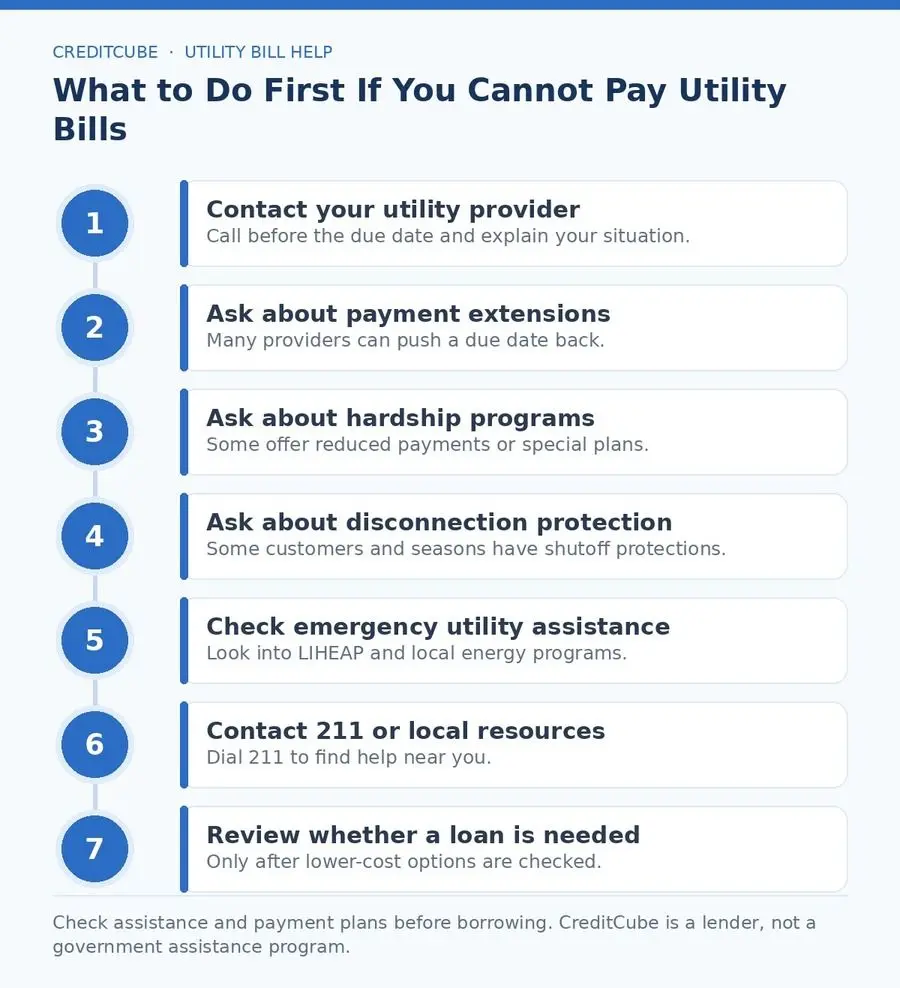
If you cannot pay a utility bill, start by contacting your provider and asking about payment extensions, hardship programs, and disconnection protection, then check assistance programs before you borrow. Here is the order to work through.
- Contact your utility provider. Call before the due date and explain your situation.
- Ask about payment extensions. Many providers can push a due date back.
- Ask about hardship programs. Some offer reduced payments or special plans.
- Ask about disconnection protection. Certain customers and seasons have shutoff protections.
- Check emergency utility assistance. Look into LIHEAP and local energy programs.
- Contact 211 or local resources. Dial 211 to find help near you.
- Review whether a loan is needed. Only after you have checked the lower-cost options.
Assistance is the first place to look, so here is a closer look at it.
Emergency Utility Assistance Options to Review
Emergency utility assistance includes government, nonprofit, and utility-provider programs that help eligible households pay energy, heating, cooling, or water bills, often without repayment. These are the main ones to review.
- LIHEAP and state energy programs. The federal LIHEAP program helps eligible low-income households with energy bills, energy crises, and weatherization. Apply through the relevant state, territory, tribal, or local administering agency. Use Energyhelp.us or call 1-866-674-6327 to find where to apply.
- Local nonprofit support. Community groups and charities may help with a bill.
- Utility hardship programs. Your provider may run its own aid or discount program.
- Payment plans. A plan spreads the balance over time, often with no new interest.
- Crisis help for shutoff notices. Some programs focus on urgent disconnection cases.
- Weatherization programs. Energy-efficiency upgrades can lower your future bills.
- 211 referrals. Dialing 211 connects you to local assistance options.
Eligibility, application timing, and funding all vary by location, household income, and program rules. When assistance cannot cover the gap in time, a loan may enter the picture.
When to Consider Loans for Utility Bills?
A loan for utility bills may be considered when the bill is essential, the shortfall is temporary, assistance is not available in time, and the repayment fits your budget. In short, it is a last resort after you have checked lower-cost help.
A few conditions should hold first. You should understand the full cost and have reviewed the alternatives. These loans can be expensive, so the payment needs to fit without strain. Options like online installment loans spread the cost over scheduled payments, which some borrowers find easier to plan.
One rule holds above all. A loan should not be used if repayment would make future rent, food, insurance, medical costs, or utility bills harder to manage. If you reach that point carefully, here is where CreditCube may fit.
CreditCube as a Utility Bill Funding Option
CreditCube is one utility-bill funding option for eligible borrowers: it offers tribal loans repaid in scheduled installments. It is not a utility provider, government aid program, grant, or charity.
If you are comparing loans for utility bills, CreditCube may be worth a look after you have checked assistance and payment plans. You apply online, and CreditCube reviews your eligibility, income, and ability to repay. If you are approved, you see the terms before signing and repay in scheduled installments. State availability may vary, and these loans can be expensive, so review the full agreement first.
CreditCube is not emergency utility assistance, and a loan cannot guarantee that a payment will prevent a shutoff. Approval, costs, and timing depend on your eligibility and the final agreement.
To see how a loan stacks up against assistance, compare them side by side.
Loans for Utility Bills vs. Emergency Utility Assistance
The main difference is repayment: emergency utility assistance often does not need to be paid back, while a loan always does. The table compares the common options.
| Option | What it is | Repayment required? | What to check |
|---|---|---|---|
| Emergency utility assistance | Government, nonprofit, or local aid for eligible households | Often no, but rules vary | Eligibility, deadline, funding availability |
| Utility payment plan | An arrangement with your utility provider | Yes | Due dates, minimum payments, shutoff protection |
| CreditCube installment loan | A tribal installment loan for eligible borrowers | Yes | Total cost, repayment schedule, fees, state availability |
| Credit card | Revolving credit used to pay bills | Yes | APR, fees, available credit, repayment plan |
| Payday loan | A short-term loan often due quickly | Yes | Fees, repayment deadline, rollover risk |
It also helps to know which bills tend to create an emergency in the first place.
Utility Bills That May Create an Emergency
The bills most likely to create an emergency are the ones tied to safety and daily life: electricity, gas, heating, cooling, and water, plus internet or phone when you need them for work or school. Here is the full picture.
- Electricity bill. Powers lights, appliances, and medical devices.
- Gas bill. Often runs heating, hot water, and cooking.
- Heating bill. Critical for safety in cold months.
- Cooling bill. Important during extreme heat.
- Water bill. Essential for daily living and health.
- Internet or phone bill. Needed for work, school, or essential contact.
- Past-due balances. Older amounts that can trigger collection or shutoff.
- Shutoff notices. A warning that service may be disconnected.
Whatever the bill, comparing loans carefully protects your budget.
Checklist: Comparing Loans Before You Apply
Before you apply, compare the total repayment amount, the APR, any fees, the payment dates, and whether you can repay without missing future bills. Run through each point below.
- Total repayment amount. The full amount you will repay.
- APR. The yearly rate that reflects interest and some fees.
- Fees. Origination or other charges beyond the amount borrowed.
- Payment dates. When each payment is due.
- Missed-payment consequences. What happens if you are late.
- Clear eligibility. Whether the lender is upfront about who qualifies.
- State availability. Whether the loan is offered where you live.
- Future-bill safety. Whether you can repay without missing next month's bills.
- Assistance checked first. Whether you have reviewed aid programs.
- Terms before signing. Whether you see the full terms in advance.
With those checks in mind, here is how CreditCube compares with other funding.
CreditCube vs. Traditional Utility Bill Funding Options
CreditCube differs from some short-term options because repayment is structured in installments rather than one lump sum. Even so, you should compare the full cost and the alternatives before signing.
Here is how it sits next to the common choices. A utility payment plan or emergency utility assistance may cost you the least. A payday loan or credit card carries its own costs and risks. A CreditCube installment loan spreads repayment over scheduled payments, but these loans can be expensive, so the total cost still matters most. However you fund a bill, using the money wisely helps.
Responsible Ways to Use Loan Funds for Utility Bills
Use loan funds only for essential bills, borrow only what you need, and have a repayment plan before you sign. These steps may help you assess borrowing risks, but they do not guarantee that a loan will be affordable or prevent further financial difficulty.
- Cover essential bills only. Put the money toward utilities and necessities.
- Prioritize safety and housing. Pay what keeps the lights, heat, and water on first.
- Borrow only what you need. With otherwise identical rates, fees, and repayment terms, a smaller principal generally reduces total repayment.** Compare the actual total cost of each offer.
- Skip non-essential spending. Keep the funds for the bills that matter.
- Plan repayment first. Know how you will pay it back before you sign.
- Payment extensions. Ask whether a later due date is available and whether fees, interest, or other conditions apply. Confirm any effect on disconnection timing before relying on the arrangement.
Just as important is knowing when a loan is the wrong move.
When You Should Consider Something Else Beside Loan?
A loan may not be the right choice when you are unsure how you will repay, the shortfall is ongoing rather than temporary, or lower-cost help is available. In those cases, borrowing tends to deepen the problem rather than solve it.
Other warning signs are worth heeding too. Hold off if you would need another loan to repay this one, or if the payment would make next month's utility bills harder to cover. And never sign before you have read the full agreement. If any of these fit, the alternatives below are the safer first step.
This section is general information, not financial advice. Only you can judge what fits your budget, and CreditCube reviews application information under its underwriting criteria but does not provide individualized financial advice or recommend whether borrowing is suitable for your circumstances.
Alternatives to Loans for Utility Bills
Alternatives to a loan include emergency utility assistance, provider hardship plans, payment extensions, local charities, and 211 referrals, among others. Several cost far less than borrowing.
- Emergency utility assistance. Programs like LIHEAP help eligible households with energy bills.
- Utility hardship plans. Your provider may offer reduced payments or aid.
- Payment extensions. A later due date can buy you time at no cost.
- Local charities. Community groups sometimes cover urgent bills.
- 211 referrals. Dial 211 to find nearby help quickly.
- Budget adjustments. Trimming other spending may free up what you need.
- Employer advance. Some employers advance part of your next check.
- Credit union small-dollar loan. Members may find low-cost small loans.
- Family or friends. A loan from someone you trust may carry no interest.
- Weatherization programs. Energy upgrades lower your future bills.
Before you apply for anything, run through one last checklist.
Checklist: Before You Apply for Utility Bill Funding
Before you apply, confirm you have contacted your provider, checked assistance, understood the total cost, and can repay without missing essentials. Answer yes to each of these first.
- I contacted my utility provider.
- I asked about emergency utility assistance.
- I checked local and state programs.
- I understand the total cost of borrowing.
- I know the repayment dates.
- I know what happens if I miss a payment.
- I can repay without missing essentials.
- I reviewed alternatives before applying.
- I read the loan agreement before signing.
Conclusion
Utility bills are essential, so the goal is to keep your service on at the lowest cost to you. Check assistance and payment plans first, since they may cost nothing to repay. Loans for utility bills may be one option for eligible borrowers after that, and CreditCube may be considered as a tribal installment loan. Whatever you choose, borrow only what you need and have a repayment plan before you sign.
FAQs About Loans for Utility Bills
Can I get loans for utility bills?
Some personal or installment loans may be used for utility bills, depending on the lender and agreement. Review emergency utility assistance and payment plans first, then compare loan costs before applying.
What is emergency utility assistance?
It may include government, nonprofit, utility-provider, or local programs that help eligible households pay energy, heating, cooling, water, or other essential utility costs.
Is CreditCube emergency utility assistance?
No. CreditCube is not a government aid program, grant, charity, or utility assistance provider. It offers tribal installment loans that must be repaid according to the agreement.
Should I use a loan to pay overdue utility bills?
A loan may be considered if the bill is essential, the shortfall is temporary, and repayment fits your budget. It may not be right if it would make future bills harder to pay.
What should I try before applying for loans for utility bills?
Contact your utility provider, ask about payment plans, check emergency utility assistance, contact local resources such as 211, and review whether lower-cost help is available.
Can loans for utility bills stop a shutoff?
A loan may provide funds you can put toward a bill, but it does not guarantee shutoff prevention. Contact your provider directly to confirm deadlines, required amounts, and disconnection rules.
What should I check before signing a loan agreement?
Review the APR, fees, total repayment amount, and payment schedule. Also check missed-payment consequences, state availability, and whether repayment fits your budget.
Recent Articles
Emergency Rent Loans for Bad Credit: Fast Options in 2026
Emergency rent loans for bad credit explained. Learn how they work, who qual...Best OneMain Financial Alternatives for Personal Loans
Personal loans available online or in-branch with secured and unsecured opti...Quick Loans in 2026: How to Apply and Get Approved Fast
Quick loans guide for 2026. Learn how to apply, approval steps, requirements...Bank Statement Loan Review: What Lenders Check
A bank statement loan review helps lenders assess income and underwriting fa...State Lending Laws: How They Shape Online Loans
State lending laws affect loan cost, terms, and availability by location. Le...AI Loan Approval Is Faster and You’ll Be Shocked How!
Discover how AI loan approval and automated underwriting are revolutionizing...Get your money today
Apply for a loan NOW!
Applying does NOT affect your FICO® Score!
Have questions?
Please call us by phone:
Credit Cube © 2026. All rights reserved
CreditCube is a Tribal enterprise, wholly owned and operated by the Big Valley Band of Pomo Indians, a federally-recognized American Indian tribe and sovereign government. Any Agreement entered into as a result of this Application shall be governed by applicable Tribal and federal law. Each aspect of communication and transaction with/on this site will be deemed to have occurred in CreditCube’s Big Valley Band of Pomo Indian Reservation offices, regardless of the location where you are accessing or viewing this site.
⚠ Please note: This is an expensive form of borrowing. CreditCube loans are designed to assist you in meeting your short-term borrowing needs and are not intended to be a long-term financial solution! Examples of emergency reasons why these loans might be used include unexpected emergencies, car repair bills, medical care, or essential travel expenses.
* Loan approvals are subject to underwriting. Approval may take longer if additional verification documents are requested. Not all loan requests are approved. CreditCube reviews your information in real-time to determine whether your information meets our lending criteria. You acknowledge that by completing and submitting the website application that you are applying for a Loan. We verify applicant information through national databases including, but not limited to, Clarity Services, Inc., a credit reporting agency, and we may pull your credit in order to determine your eligibility and ability to repay.
** Maximum loan amount is $500 for first-time customers. For returning CreditCube customers, rates may go down over time based on your CreditCube Loyalty Program status and your payment history with us. Please see our Loyalty Program page for more information.
*** Loan Applications processed and approved before 3pm EST Monday-Friday are typically funded on the next business day. Example: If your loan is processed and approved on Friday before 3pm EST, the loan will typically be funded on the following Monday. Deposit times may vary depending on your bank. Business Day means Monday through Friday excluding all federal banking holidays.
CreditCube does not lend to residents of Pennsylvania, Connecticut, Minnesota, New York, Vermont, Virginia, West Virginia, Illinois, Georgia and North Carolina. Availability of installment loans in your state is subject to change at any time with or without notice at the sole discretion of CreditCube.