Emergency Rent Assistance: A Guide to Emergency Funding

Emergency rent assistance is help with current rent, past-due rent, or utilities through local, state, tribal, nonprofit, or housing programs, and it often doesn’t need to be repaid. When rent is past due, that assistance is the first place to look, along with landlord payment plans and legal support if eviction is possible. Availability and eligibility vary by program, so start with the resources near you.
If assistance is slow or does not cover the full amount, some renters compare other funding for rent, including payment plans, employer advances, savings, or installment loans. A hardship loan is one such option, and CreditCube offers tribal installment loans for eligible borrowers. CreditCube is not a rent assistance program, grant, or government benefit, so a loan should be reviewed carefully before you sign because repayment costs and obligations still apply.
This article is general information, not financial or legal advice. Borrowing carries risk, and any loan should be reviewed carefully before you sign.
What to Do First If You Are Behind on Rent
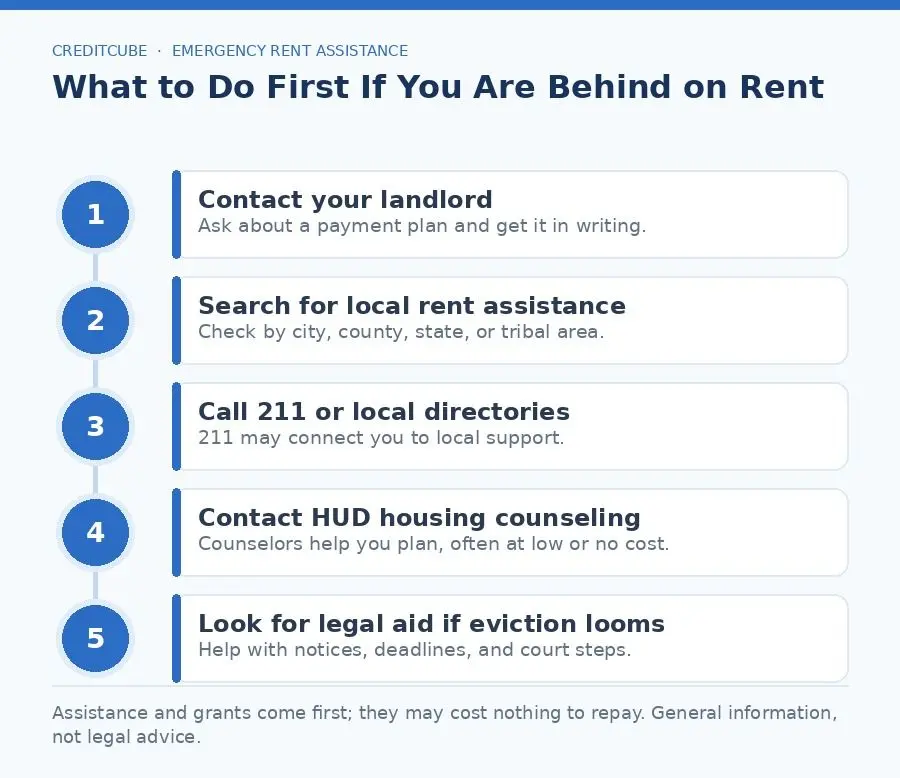
If you are behind on rent, the first steps are to contact your landlord, look for local emergency rent assistance, and call 211 before you consider borrowing. Work through them in order.
- Contact your landlord or property manager Ask whether a payment plan is possible, and get any agreement in writing. Do not ignore notices, since timing matters once an eviction process starts.
- Search for local emergency rent assistance Search by city, county, state, or tribal area, and check government and nonprofit resources. USA.gov suggests you contact your state to find emergency help paying your rent. Availability may change based on funding.
- Call 211 or search local resource directories Calling 211 may connect renters with local nonprofit, housing, food, utility, and emergency support.
- Contact HUD-approved housing counseling Housing counselors may help renters understand their options and build a plan, often at low or no cost. Learn more about HUD housing counseling.
- Look for legal aid if eviction is possible Legal aid may help renters understand rights, notices, deadlines, and court steps. Rules vary by location, so local guidance matters.
Emergency Rent Assistance vs. Funding for Rent
The key difference is repayment: emergency rent assistance often does not need to be repaid, while funding for rent such as a loan always does. The table compares the common options.
| Option | What it may do | What to check |
|---|---|---|
| Emergency rent assistance | May help with rent, arrears, or utilities | Eligibility, funding availability, documents |
| Landlord payment plan | May spread missed rent over time | Written terms, due dates, late fees |
| Nonprofit support | May offer short-term rent or utility help | Local availability and income rules |
| Employer advance | May provide early access to earned wages | Payroll rules and future paycheck impact |
| Savings or family support | May avoid new debt | Whether it creates another shortfall |
| Installment loan | May provide funds if approved | Total cost, APR, fees, repayment ability |
Assistance and grants come first because they may cost nothing to repay.
Where to Find Emergency Rent Assistance
Emergency rent assistance comes mainly from local, state, and tribal programs, public housing agencies, nonprofits, 211, and HUD housing counselors. Each is worth checking.
- Local government programs. City, county, state, and tribal programs may offer rent help.
- Public housing agencies. They may provide information on local housing support.
- Nonprofit and faith-based organizations. Availability depends on your area.
- 211. A resource for local referrals to rent and utility help.
- HUD housing counseling. A source of housing guidance.
- Legal aid. Useful for eviction notices, court papers, or rent-related debt collection.
According to the CFPB, state, tribal, and local organizations are the best place to start, and rental assistance funds can take several weeks to arrive after you apply. That timing is why it helps to know which documents to prepare.
Documents You May Need to Request Assistance
To request assistance, you may need a photo ID, your lease, a past-due rent notice, and proof of income. Having them ready can speed up the review.
- Photo ID. To confirm your identity.
- Lease or rental agreement. To show your tenancy and rent amount.
- Past-due rent notice. To document what you owe.
- Eviction notice, if applicable. To show urgency.
- Proof of income. To confirm eligibility.
- Proof of job loss or hardship. To support a hardship claim.
- Utility bills. If utilities are part of the request.
- Landlord contact information. So the program can reach them.
- Bank statements, if requested. Some programs ask for them.
- Household size information. To check income limits.
Document requirements vary by program, so check the specific one before applying. If assistance cannot come through in time, here are faster options to weigh.
What If Emergency Rent Assistance Is Not Available Fast Enough?
If assistance is slow or limited, you can ask your landlord for more time, check utility help, or compare other funding options before you borrow. Assistance programs may have wait times or limited funding, so a backup plan helps.
- Ask for a short payment extension. A few extra days can bridge a gap.
- Ask about a partial payment plan. Paying part now may help, but it may not stop an eviction process, so get any agreement in writing.
- Check utility assistance. If utilities are part of the crisis, separate programs may help.
- Reduce non-essential expenses temporarily. A short cutback can free up cash.
- Ask your employer about a paycheck advance. Some employers offer an advance on your next paycheck, so ask whether any fees or repayment terms apply.
- Consider family or community support. Help from family may carry no interest.
- Review borrowing only if repayment is realistic. Options like an urgent loan come last, after lower-cost routes.
A loan is a last resort here, not a first move. Still, some renters do ask whether a loan can cover rent.
Can You Use a Loan for Emergency Rent?
You may be able to use a loan for emergency rent if assistance and payment plans are not available or do not cover the full amount, but borrowing adds obligations. A loan brings repayment duties, fees, and possible interest. Missing a payment may lead to late fees, collection activity, and a possible negative impact on your credit.
Before using any loan for rent, compare the total cost, the payment schedule, the missed-payment consequences, and whether the payments fit your budget. Rent is a recurring cost, so a loan should not make next month harder. Loans for similar urgent needs, such as emergency moving loans, may also use an installment structure, and the same cautions apply.
CreditCube offers tribal installment loans for eligible borrowers. CreditCube is not an emergency rent assistance program, grant, or government benefit. If approved, repayment is made through scheduled installments according to the loan agreement. Availability, approval, loan amount, costs, and funding timing depend on eligibility, state availability, bank processing, and the final agreement.
When a Loan for Rent May Make Sense
A loan for rent may make sense when the rent gap is temporary, your income is stable, and the payments fit your budget. In short, it fits when the shortfall is short-term and you can repay without strain.
- The rent gap is temporary.
- You have a clear repayment plan.
- Your income is stable enough to make payments.
- You have reviewed assistance programs first.
- The loan payment does not prevent you from paying essentials.
- You understand the full cost before signing.
When these line up, borrowing may be reasonable. When they do not, a different path is usually safer.
Signs Borrowing for Rent Could Backfire
Borrowing for rent can backfire when you already cannot cover monthly essentials, your income is uncertain, or you have not spoken with your landlord. Watch for these signs:
- You already cannot cover monthly essentials.
- You are unsure how you will repay.
- You would need another loan to repay this one.
- Your income has stopped or is uncertain.
- You have not spoken with your landlord.
- You have not checked local emergency rent assistance.
- The payment would make next month’s rent harder to afford.
If any of these fit, pause and review your options first.
Checklist: Comparing Funding for Rent Before You Choose
Before choosing any funding for rent, confirm the total amount needed, the rent due date, and whether assistance is available. Run through each point.
- Total amount needed.
- Due date for rent.
- Whether eviction has started.
- Assistance program availability.
- Payment plan terms.
- Total loan repayment amount.
- APR and fees.
- Payment schedule.
- Missed-payment consequences.
- Whether future rent will still be affordable.
The answers show which option fits. If a loan is the one that fits, here is where CreditCube comes in.
CreditCube as a Tribal Installment Loan Option
CreditCube may be one option for eligible borrowers comparing funding for rent. CreditCube offers tribal installment loans with repayment through scheduled installments. It is not a rent assistance program, and approval is not guaranteed. This is an expensive form of borrowing with high APRs. Review the current Rates & Terms and your final loan agreement for the applicable APR, fees, and total repayment amount.
Before applying, review whether the loan payment fits your budget and whether you have checked lower-cost or no-cost resources first. For other household costs, our guide to home improvement loans covers how these loans work. Review CreditCube’s installment loan option and terms before applying.
Your Pre-Borrowing Rent Checklist
Before borrowing for rent, confirm you have contacted your landlord, searched for assistance, and can make the scheduled payments. Answer yes to each.
- I contacted my landlord or property manager.
- I searched for emergency rent assistance in my area.
- I checked 211, housing counseling, or nonprofit resources.
- I know the exact rent amount due.
- I understand the total cost of borrowing.
- I can make the scheduled payments.
- I know what happens if I miss a payment.
- I have read the full agreement before signing.
Still have questions? These come up often.
FAQs About Emergency Rent Assistance and Funding for Rent
What is emergency rent assistance?
Emergency rent assistance refers to local, state, tribal, nonprofit, or housing resources that may help renters pay current rent, past-due rent, utilities, or related housing costs. Availability and eligibility vary by program.
Where can I find emergency rent assistance near me?
Start with your city, county, state, or tribal housing resources. You can also call 211, contact a HUD-approved housing counselor, or check local nonprofit organizations.
What is the difference between emergency rent assistance and a rent loan?
Emergency rent assistance may come from government or nonprofit programs and may not need to be repaid. A rent loan is borrowed money that must be repaid according to the loan agreement.
Can CreditCube help with funding for rent?
CreditCube offers tribal installment loans for eligible borrowers. It is not a government rent assistance program or grant. If approved, funds may be used according to the loan agreement, and repayment is required.
Is borrowing for rent a good idea?
Borrowing for rent may make sense only when the rent gap is temporary, repayment is realistic, and lower-cost or no-cost resources have been reviewed first. It may not fit if you are already unable to cover ongoing monthly expenses.
What documents do I need for emergency rent assistance?
Common documents may include ID, a lease, a past-due rent notice, proof of income, hardship documentation, utility bills, and landlord contact information. Requirements vary by program.
What should I do if I receive an eviction notice?
Do not ignore the notice. Contact your landlord, search for emergency rent assistance, and look for local legal aid or housing counseling. Rules and deadlines vary by location.
Recent Articles
How Does Credit Score Affect Your Life in 2026?
How does your credit score affect your life? Learn how it shapes loans, hous...AI Credit Scoring in 2026: How Lenders Use Algorithms
AI credit scoring explained: learn how lenders use AI models, alternative da...Anaheim CA Loans: What to Review Before You Apply
Anaheim CA loans may include several borrowing options. Compare costs, terms...Happiness skills to pay off your debt
Getting out of debt is possible if you have the right tools and motivation. ...How Credit Card Debt Affects Your Life?
Being irresponsible with credit cards can lead to a financial disaster and a...Top Debt Payoff Strategies That Actually Work
Discover proven paying off debt strategies in 2025—debt snowball, avalanche,...Get your money today
Apply for a loan NOW!
Applying does NOT affect your FICO® Score!
Have questions?
Please call us by phone:
Credit Cube © 2026. All rights reserved
CreditCube is a Tribal enterprise, wholly owned and operated by the Big Valley Band of Pomo Indians, a federally-recognized American Indian tribe and sovereign government. Any Agreement entered into as a result of this Application shall be governed by applicable Tribal and federal law. Each aspect of communication and transaction with/on this site will be deemed to have occurred in CreditCube’s Big Valley Band of Pomo Indian Reservation offices, regardless of the location where you are accessing or viewing this site.
⚠ Please note: This is an expensive form of borrowing. CreditCube loans are designed to assist you in meeting your short-term borrowing needs and are not intended to be a long-term financial solution! Examples of emergency reasons why these loans might be used include unexpected emergencies, car repair bills, medical care, or essential travel expenses.
* Loan approvals are subject to underwriting. Approval may take longer if additional verification documents are requested. Not all loan requests are approved. CreditCube reviews your information in real-time to determine whether your information meets our lending criteria. You acknowledge that by completing and submitting the website application that you are applying for a Loan. We verify applicant information through national databases including, but not limited to, Clarity Services, Inc., a credit reporting agency, and we may pull your credit in order to determine your eligibility and ability to repay.
** Maximum loan amount is $500 for first-time customers. For returning CreditCube customers, rates may go down over time based on your CreditCube Loyalty Program status and your payment history with us. Please see our Loyalty Program page for more information.
*** Loan Applications processed and approved before 3pm EST Monday-Friday are typically funded on the next business day. Example: If your loan is processed and approved on Friday before 3pm EST, the loan will typically be funded on the following Monday. Deposit times may vary depending on your bank. Business Day means Monday through Friday excluding all federal banking holidays.
CreditCube does not lend to residents of Pennsylvania, Connecticut, Minnesota, New York, Vermont, Virginia, West Virginia, Illinois, Georgia and North Carolina. Availability of installment loans in your state is subject to change at any time with or without notice at the sole discretion of CreditCube.