Preparing for Unexpected Home Repairs: Evaluating Emergency Home Repair Loans

Unexpected home repairs can create urgent financial pressure, especially when the issue affects safety, heating, plumbing, or daily living. Emergency home repair loans may be one way to cover repair costs, but they are not the only option. Before applying, compare payment plans, insurance, savings, assistance programs, and credit products. Our guide to home improvement loans covers one of those routes, and installment loans such as those from CreditCube are another.
This article is general information, not financial or legal advice. Borrowing carries risk, and any loan should be reviewed carefully before you sign.
What Are Emergency Home Repair Loans?
Emergency home repair loans are financing options used to cover urgent repair costs when savings or insurance fall short. They may include personal loans, installment loans, home equity loans, or other credit products.
These loans share a few traits:
- They fund urgent repairs. Think plumbing, heating, electrical, or safety fixes.
- They come in several forms. Each has its own costs and terms.
- They need review first. Check the total cost and your repayment ability before you borrow.
Home repair financing can help in a pinch, but it is still debt. The next section covers which repairs tend to need fast funding.
Common Emergency Home Repairs That May Need Fast Funding
The repairs that need fast funding are usually the ones tied to safety or daily living. Here are common examples:
- Plumbing leaks. Water damage can spread fast.
- Broken heating or cooling. A safety risk in extreme weather.
- Electrical hazards. A fire or shock risk.
- Roof damage. It can worsen with each storm.
- Storm-related repairs. Urgent after severe weather.
- Water damage. It can affect health and structure.
- Broken essential appliances. Such as a water heater.
- Safety or accessibility repairs. To keep the home livable.
A loan will not solve every repair problem, and not every applicant will qualify. Before borrowing, it helps to compare all your funding options.
Funding Home Repairs: What Options Should You Compare First?
Funding home repairs starts with comparing every option, from savings and insurance to credit and government programs. The table shows how each may help and what to watch.
| Option | May help with | Key risk / limitation |
|---|---|---|
| Emergency savings | Smaller urgent repairs | May reduce cash reserves |
| Insurance claim | Covered damage | Deductibles, exclusions, claim delays |
| Contractor payment plan | Spreading repair cost | Terms vary by provider |
| Credit card | Smaller repair costs | Interest may be high if not paid quickly |
| Personal loan | Lump-sum repair funding | Costs and eligibility vary |
| Home equity loan / HELOC | Larger repairs | Home may be collateral |
| Government/community program | Eligible homeowners | Income, location, property rules |
| Tribal installment loan | Eligible borrowers needing scheduled repayment | Costs may be high; availability varies |
Government assistance is worth a look first. According to USA.gov, eligibility for these programs may depend on your income, age, location, and property type. Next, here is how loans compare with home equity options.
Emergency Home Repair Loans vs. Home Equity Options
The main difference is collateral: personal or installment loans may not require home equity, while home equity loans and HELOCs use your home to secure the debt. That trade-off matters.
- Personal or installment loans may not require home equity.
- Home equity loans and HELOCs may be used for larger repairs.
- Equity-based financing can put the home at risk if payments are missed.
Compare cost, timing, collateral, repayment length, and eligibility before you choose. The right fit depends on your situation, not on one option being universally safer.
When an Emergency Home Repair Loan May Make Sense
An emergency home repair loan may make sense when the repair is urgent, affects basic living, and the repayment fits your budget. In short, it fits when the need is real and the math works.
- The repair is urgent and cannot safely wait.
- It affects basic living conditions.
- You have compared non-loan alternatives.
- The repayment schedule fits your budget.
- The total cost is clear before signing.
- You understand the consequences of missed payments.
When these line up, borrowing may be reasonable. When they do not, a different path is usually safer.
When a Loan May Not Be the Right Choice
A loan may not be the right choice when the repair is cosmetic, can wait, or would strain your essential bills. In those cases, borrowing tends to add pressure.
- The repair is cosmetic or can wait.
- You are unsure how you will repay.
- You already have multiple overdue debts.
- The loan would prevent you from covering essentials.
- You have not reviewed lower-cost options.
- The repair may be covered by insurance or assistance.
If any of these fit, review the alternatives below before you apply.
CreditCube and Emergency Home Repair Costs
CreditCube offers tribal installment loans for eligible borrowers. If you are evaluating emergency home repair loans, CreditCube may be one option to review when you need scheduled repayment instead of a lump-sum payday-style payment. However, CreditCube loans are a high-cost form of credit, with APRs much higher than many other forms of credit. Review the APR, fees, and total repayment amount in your loan agreement before you sign.
The process is straightforward:
- Online application. You apply through the website.
- Eligibility review. CreditCube checks whether you qualify.
- Agreement review before signing. You read the terms first.
- Scheduled installment repayment. You repay on a set plan.
- Clear review of terms before accepting. Nothing is final until you sign.
Availability, approval, loan amount, costs, repayment terms, and funding timing depend on eligibility, state availability, bank processing, and the final loan agreement. These loans can be expensive, and missed payments may lead to late fees, collection activity, and a possible negative impact on your credit. Review the full agreement before you sign. For more on how one loan type works, see our guide to personal loans.
Comparing Emergency Home Repair Loans Before You Apply
Before you apply, confirm you know the total repayment amount, the APR, the fees, and whether the repair can wait. Run through each question below.
- Total repayment. What is the total repayment amount?
- APR. What is the APR?
- Fees. Are there fees?
- Payment dates. What are the payment dates?
- Missed payments. What happens if a payment is missed?
- Urgency. Is the repair essential or can it wait?
- Contractor plan. Is there a payment plan from the contractor?
- Insurance. Is the repair covered by insurance?
- Programs. Are government or community programs available?
- Budget fit. Does the repayment fit your budget?
The answers tell you whether a loan is the right move. If it is not, several alternatives may help.
Alternatives to Emergency Home Repair Loans
Alternatives to a loan include insurance claims, contractor payment plans, savings, government assistance, and community support. Several cost less than borrowing.
- Insurance claim. Good for covered damage, but deductibles and claim timing matter.
- Contractor payment plan. Some repair providers may allow scheduled payments.
- Emergency savings. Useful if it avoids new debt and does not create another shortfall.
- Government or local repair assistance. HUD, state, and some USDA programs may support eligible homeowners. The USDA notes its Rural Development loans may be used to repair, improve, or modernize homes, or remove health and safety hazards.
- Credit union or bank loan. May help borrowers who qualify and can compare terms.
- Credit card. May work for smaller costs, but interest can become expensive.
- Family or community support. May reduce or avoid borrowing, depending on the situation.
Confirm eligibility for any program in your state before relying on it. If a loan still fits, one last checklist helps.
Responsible Borrowing Checklist for Home Repairs
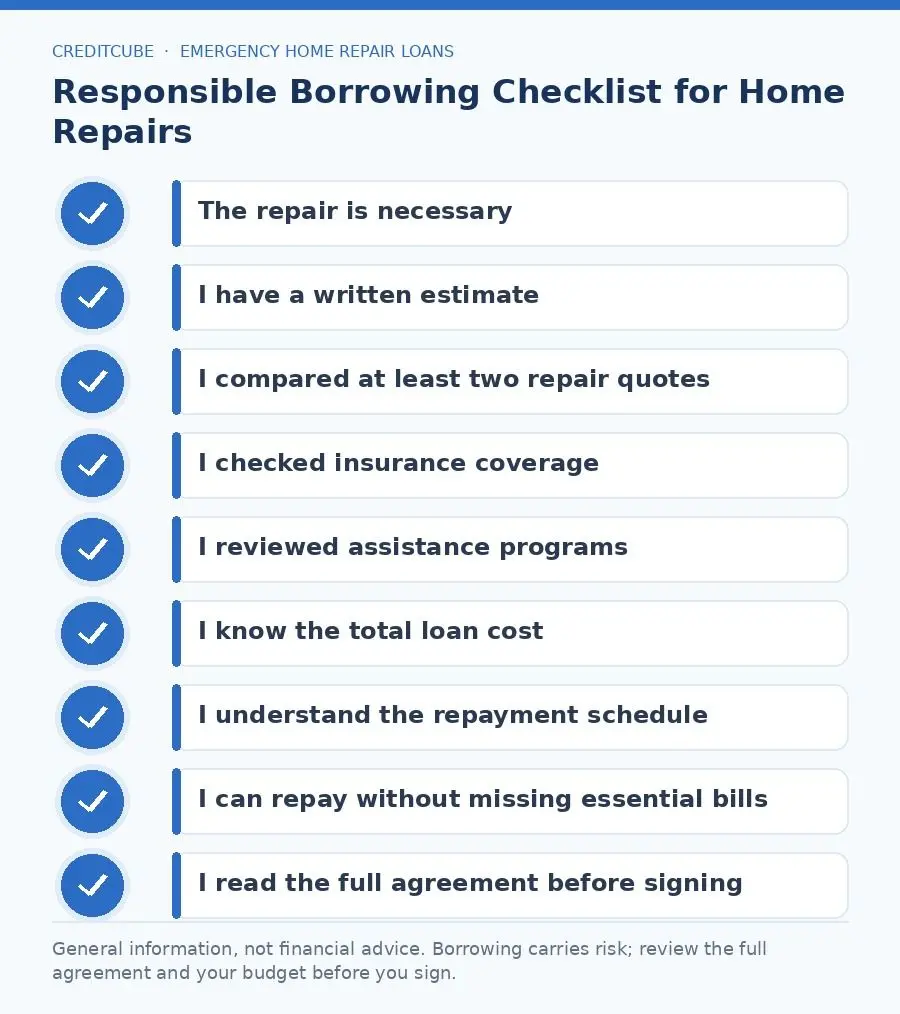
Before you borrow for a repair, confirm the repair is necessary, you have an estimate, and you can repay without missing essentials. Answer yes to each of these.
- I know the repair is necessary.
- I have a written estimate.
- I compared at least two repair quotes if time allows.
- I checked insurance coverage.
- I reviewed assistance programs.
- I know the total loan cost.
- I understand the repayment schedule.
- I can repay without missing essential bills.
- I read the full agreement before signing.
Still have questions? These come up often.
FAQs About Emergency Home Repair Loans
What are emergency home repair loans?
Emergency home repair loans are financing options used to cover urgent repair costs, such as plumbing, heating, electrical, roofing, or safety-related repairs. They may include personal loans, installment loans, home equity loans, or other credit products.
Can I use a personal loan for emergency home repairs?
Yes, some personal loans may be used for home repairs. A home repair loan can refer to several loan types, including personal loans or home equity loans.
What is the best way of funding home repairs?
The best option depends on urgency, cost, eligibility, insurance coverage, available savings, repayment ability, and whether assistance programs are available. Compare options before choosing a loan.
Are emergency home repair loans guaranteed?
No. Approval, loan amount, terms, costs, and funding timing depend on lender review, eligibility, state availability, bank processing, and the final loan agreement.
Are there alternatives to emergency home repair loans?
Yes. Alternatives may include insurance claims, contractor payment plans, emergency savings, credit cards, home equity products, government assistance, or local repair programs.
When should I avoid borrowing for home repairs?
Avoid borrowing if the repair can wait, repayment does not fit your budget, you have not reviewed alternatives, or the loan would make it harder to cover essential expenses.
Recent Articles
How Real‑Time Funding Empowers Small Businesses
Explore how real-time funding empowers small businesses with instant approva...AI Credit Scoring in 2026: How Lenders Use Algorithms
AI credit scoring explained: learn how lenders use AI models, alternative da...Installment Loans to Build Credit: Smart Steps for 2026
Installment loans to build credit can improve your credit score over time. L...Personal Loans Tampa FL: Streamline Your Application
Personal loans in Tampa, FL start with prep. Learn what to ready, how FL fun...Personal Loans Jacksonville FL: Apply With Confidence
Personal loans Jacksonville FL made clear: see what streamlines your applica...How Credit Card Debt Affects Your Life?
Being irresponsible with credit cards can lead to a financial disaster and a...Get your money today
Apply for a loan NOW!
Applying does NOT affect your FICO® Score!
Have questions?
Please call us by phone:
Credit Cube © 2026. All rights reserved
CreditCube is a Tribal enterprise, wholly owned and operated by the Big Valley Band of Pomo Indians, a federally-recognized American Indian tribe and sovereign government. Any Agreement entered into as a result of this Application shall be governed by applicable Tribal and federal law. Each aspect of communication and transaction with/on this site will be deemed to have occurred in CreditCube’s Big Valley Band of Pomo Indian Reservation offices, regardless of the location where you are accessing or viewing this site.
⚠ Please note: This is an expensive form of borrowing. CreditCube loans are designed to assist you in meeting your short-term borrowing needs and are not intended to be a long-term financial solution! Examples of emergency reasons why these loans might be used include unexpected emergencies, car repair bills, medical care, or essential travel expenses.
* Loan approvals are subject to underwriting. Approval may take longer if additional verification documents are requested. Not all loan requests are approved. CreditCube reviews your information in real-time to determine whether your information meets our lending criteria. You acknowledge that by completing and submitting the website application that you are applying for a Loan. We verify applicant information through national databases including, but not limited to, Clarity Services, Inc., a credit reporting agency, and we may pull your credit in order to determine your eligibility and ability to repay.
** Maximum loan amount is $500 for first-time customers. For returning CreditCube customers, rates may go down over time based on your CreditCube Loyalty Program status and your payment history with us. Please see our Loyalty Program page for more information.
*** Loan Applications processed and approved before 3pm EST Monday-Friday are typically funded on the next business day. Example: If your loan is processed and approved on Friday before 3pm EST, the loan will typically be funded on the following Monday. Deposit times may vary depending on your bank. Business Day means Monday through Friday excluding all federal banking holidays.
CreditCube does not lend to residents of Pennsylvania, Connecticut, Minnesota, New York, Vermont, Virginia, West Virginia, Illinois, Georgia and North Carolina. Availability of installment loans in your state is subject to change at any time with or without notice at the sole discretion of CreditCube.